Tianmen Mountain: A Hole in the Sky, and the Art of Not Looking Down
Central
On this page
Most mountains make you travel to them.
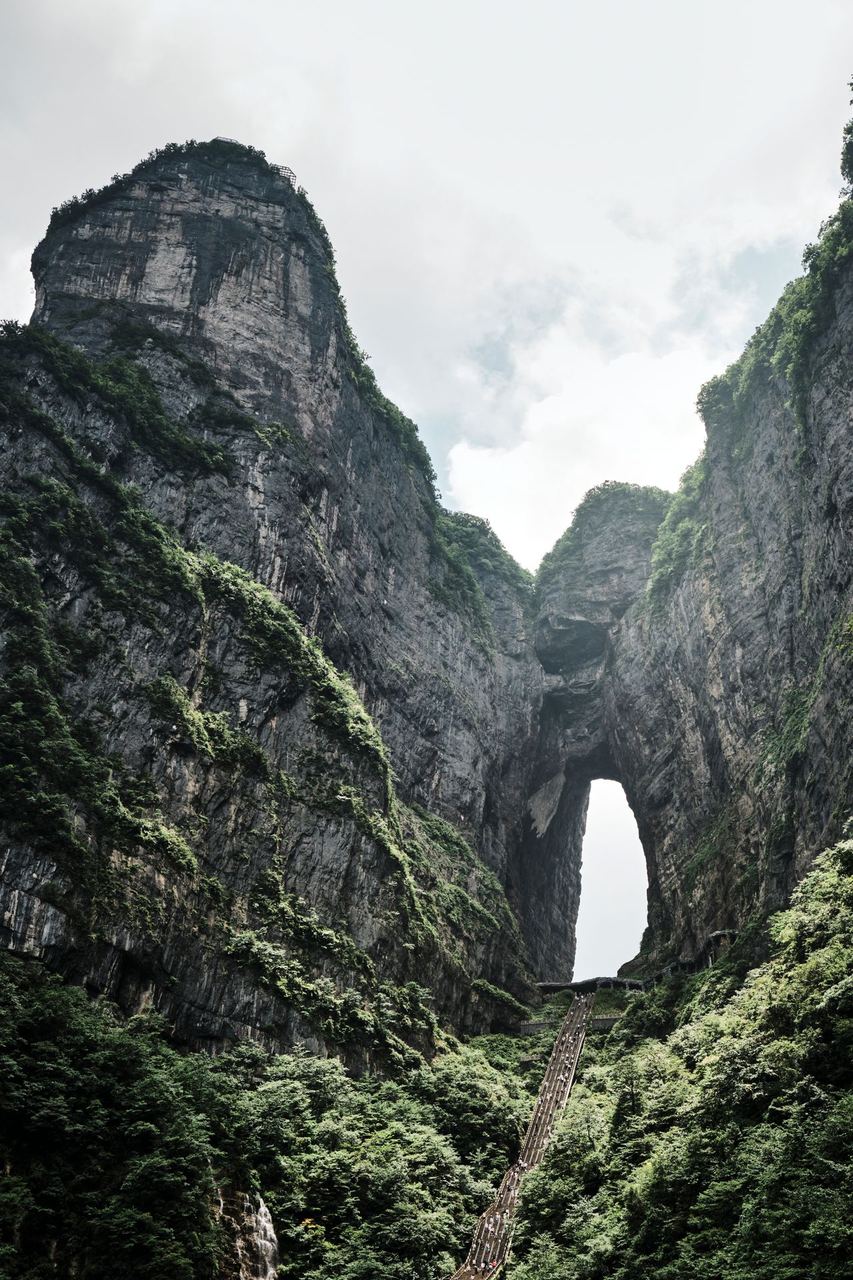
Tianmen is already there when you come out of the train station. You look up from a perfectly ordinary street in Zhangjiajie city — noodle shops, e-bikes, a man selling phone cases — and there is a 1,500-metre limestone wall standing over the rooftops with a hole punched clean through the top of it.
The cable car station is about a kilometre from the railway station. You can walk to it. That is the strange thing about this mountain: there is no approach, no trek in, no gradual sense of leaving town. You queue in the city, get into a small glass box, and a few minutes later the rooftops are gone and you are hanging over a forest.
So let’s be honest from the start, because most guides to this place are written by people who enjoy this sort of thing. Tianmen Mountain is a theme park bolted onto a sacred mountain, and almost every famous thing on it involves being high up with not very much underneath you. The good news is that nearly all of it is optional, and the mountain is still worth the day if you take the optional parts out.
Here’s what the day actually feels like, in order, with the bail-out at each stage.
First: the thing this mountain is not
Half the people who arrive here are looking for the floating pillars from Avatar. Those are somewhere else.
Zhangjiajie National Forest Park (Wulingyuan) — the sandstone columns, the Hallelujah Mountain, the glass elevator — is a different mountain, about an hour away, with a completely separate ticket (we cover it in its own guide). Tianmen is the one with the arch and the cable car, right in the city.
They’re commonly done as two days of the same trip, and they are not interchangeable. If you have one day and you came for the Avatar scenery, go to Wulingyuan and skip this page. If you have one day and you want the arch, the glass and the road with 99 bends, read on.
The cable car, and the first fifteen minutes
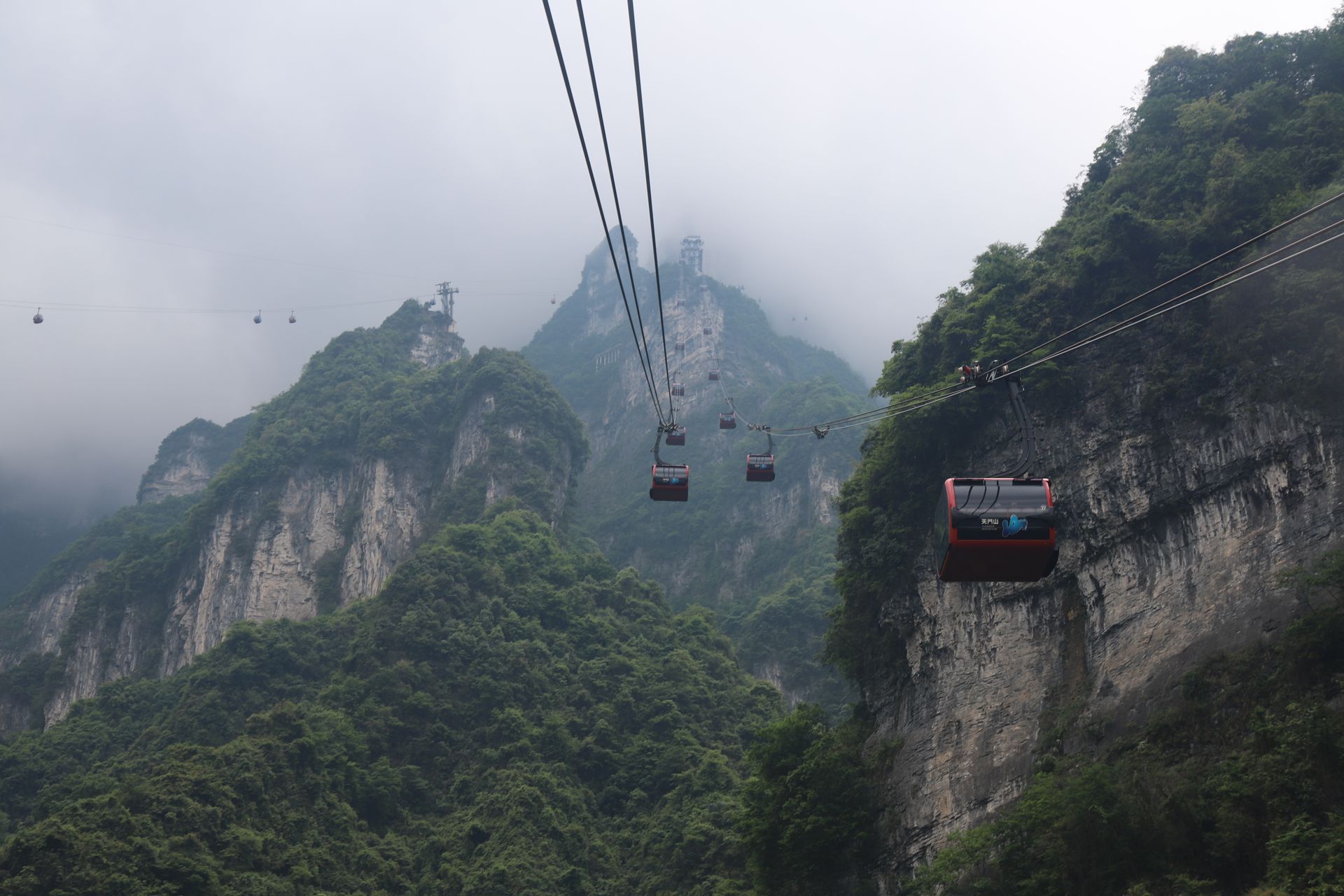
7,455 metres long. 1,277 metres of vertical. About 28 minutes. When it opened it was the longest passenger cableway of its kind in the world, and the ride is genuinely the main event — not the transport to the main event.
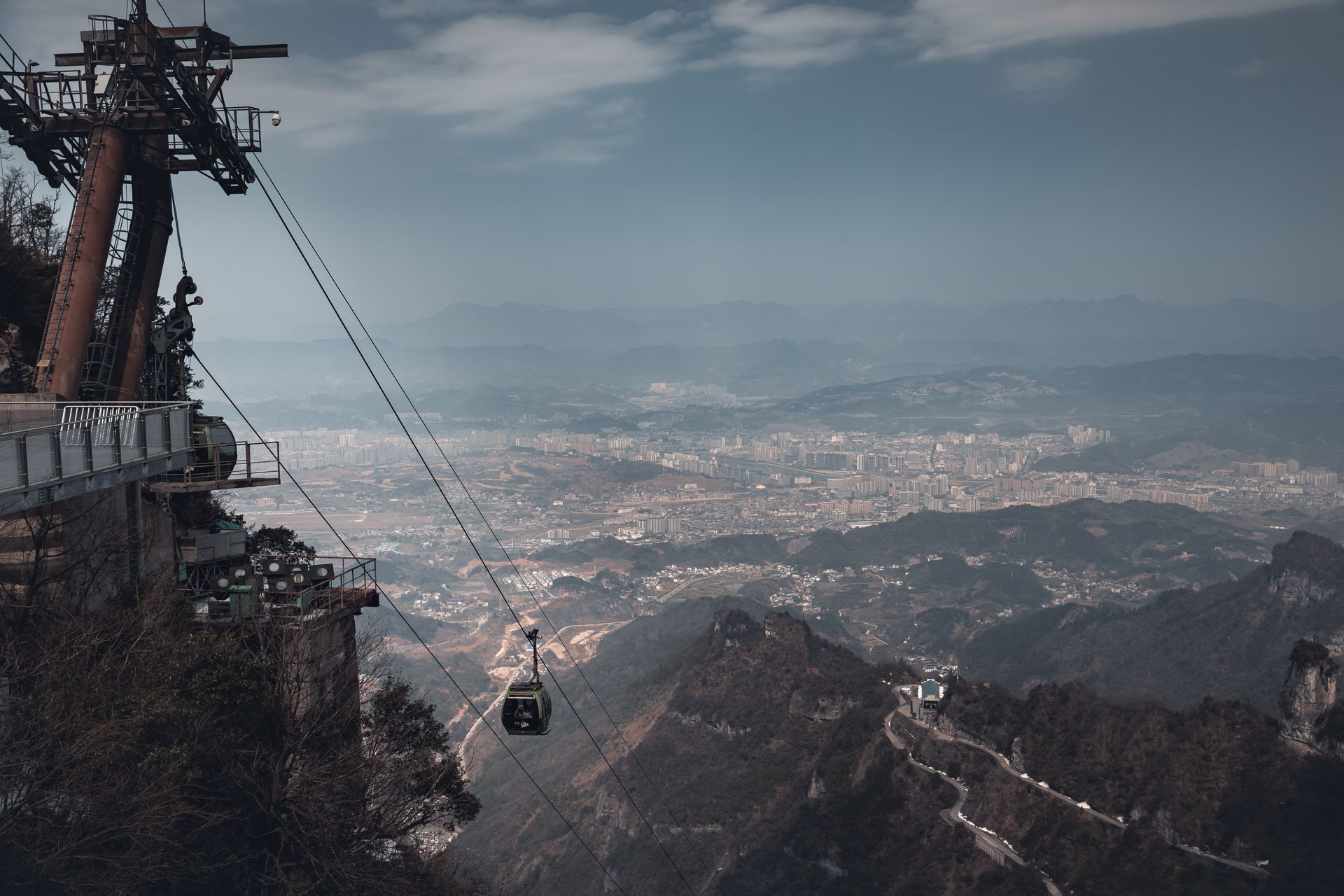
You start in the city. The cabins hold eight, they go up at about 6 m/s, and the first stretch drifts over apartment blocks, vegetable plots and somebody’s laundry, which is oddly comforting. Then the ground drops away and does not come back.
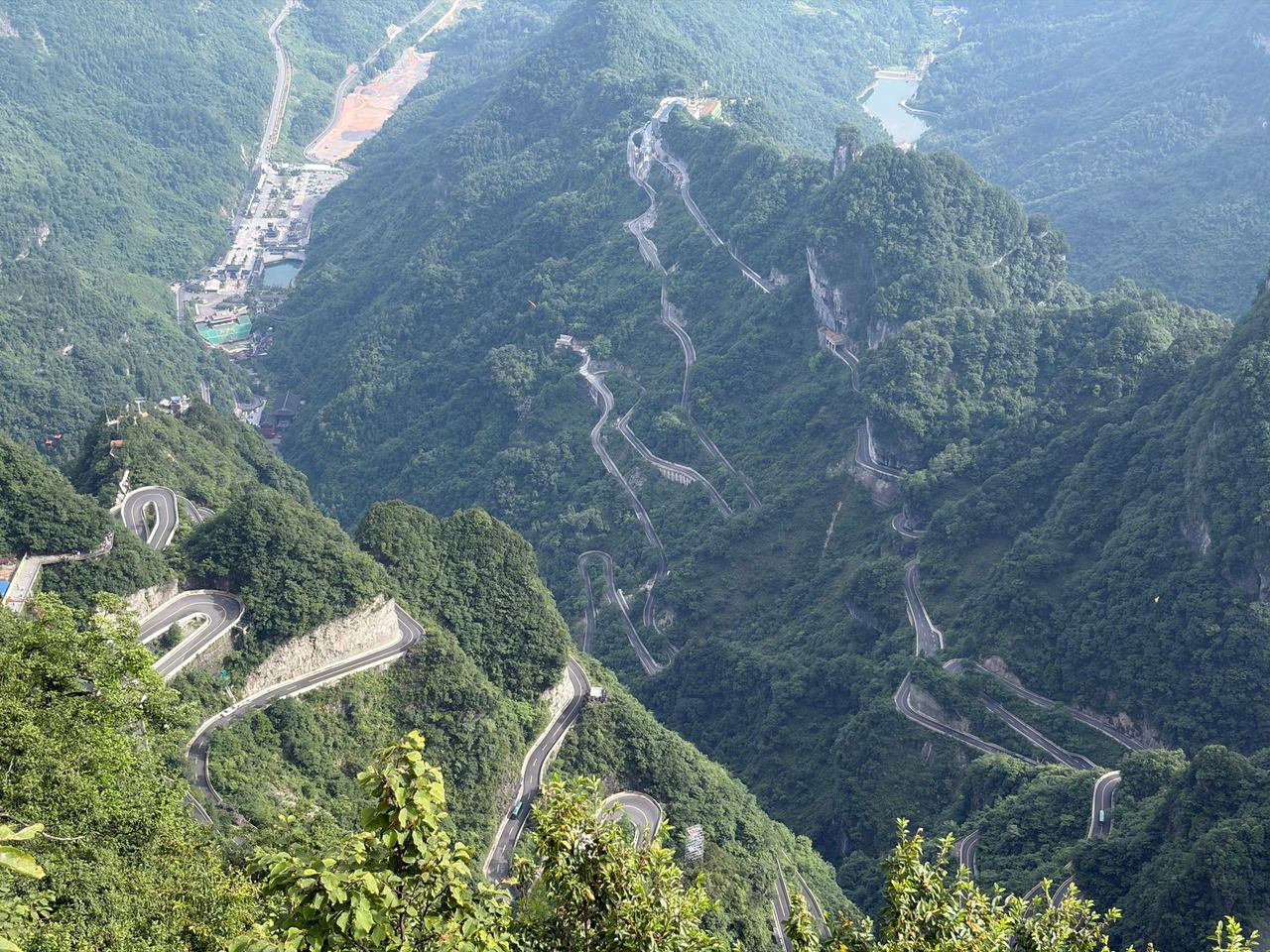
The part that catches people out is the middle. The cable crosses over the 99-bend road, and for about a minute you are looking straight down at cars doing hairpins several hundred metres below you, on a slope steep enough that the road looks folded rather than built. At the steepest section the line climbs at nearly 39 degrees. The cabin is quiet, the cable hums, and your body — which has correctly worked out that it is in a glass box in the sky — will have opinions.
The bail-out: sit in the middle, back to the direction of travel, and look at the far horizon rather than down. It is 28 minutes and there is nowhere to get off, so the one thing you can control is where you point your eyes. If you know that a long cable car is beyond you, there is a route that skips it entirely — see the next section.
The decision you make before you buy: A, B or C
This is the single most important paragraph on this page, and it’s the thing foreign visitors most often get wrong.
Tianmen sells one ticket at one price — ¥285 for adults — but you must choose a route (A, B or C) and a timed entry slot when you book. The routes are different physical ways around the mountain, they cost the same, and you generally cannot change your mind at the gate. Since 2025 there’s an extra sting: if you miss your A or B time slot, you can be automatically downgraded to C.
Broadly:
- Route A — big cable car up from the city, walk the summit, then down through the mountain to Tianmen Cave, then out to the cave plaza and back to town by the shorter cableway and shuttle. No backtracking, least climbing. The default choice.
- Route B — the same loop in reverse: shuttle out of town, short cableway up, then climb the 999 steps from the cave to the summit, and take the big cable car back down to the city. Shorter queues at busy times, considerably more work for your legs.
- Route C — the short cableway up and back down, no big cable car, out and back the same way. This is the route for anyone who doesn’t want the 7.5 km ride, and for people travelling with grandparents, small children or a tight schedule.
⚠️ One live caveat, and please check it before you book. The upper section of the big cable car was taken out of service in November 2025 for a rebuild, which forced temporary re-routing of A and B (with a shuttle bus up the 99-bend road standing in for part of the ride). Reports say it came back in March 2026; we have not been able to confirm that with a clear official notice, and some route descriptions were still showing the temporary arrangement afterwards. Check the scenic area’s own WeChat account (张家界天门山景区) or the mini-program on the day you book, and treat any route map — including ours — as a description of the normal state of affairs rather than a promise.
The summit, where the mountain gets its own back
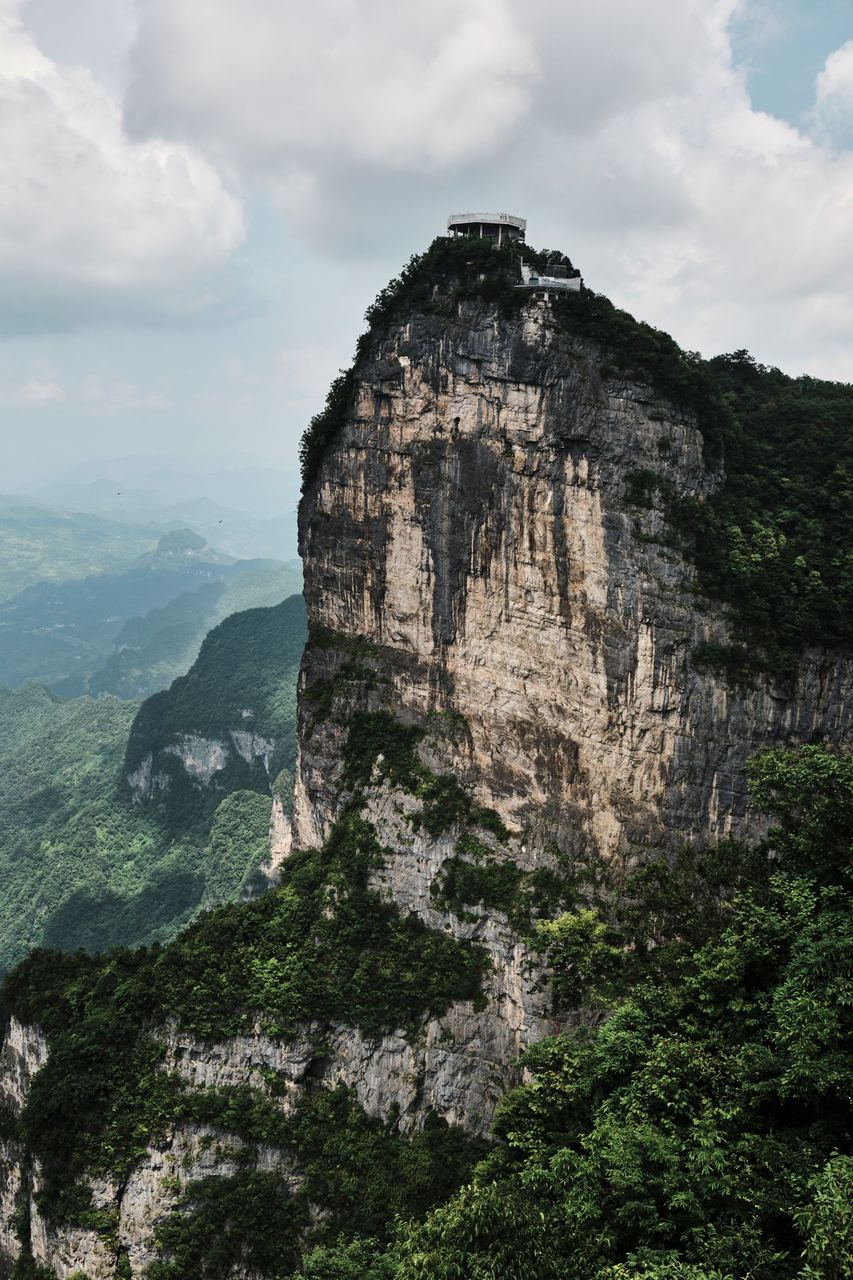
Up top you are at around 1,400–1,500 metres, on a plateau of dwarf forest with two cliff-edge loops hung off the sides of it.
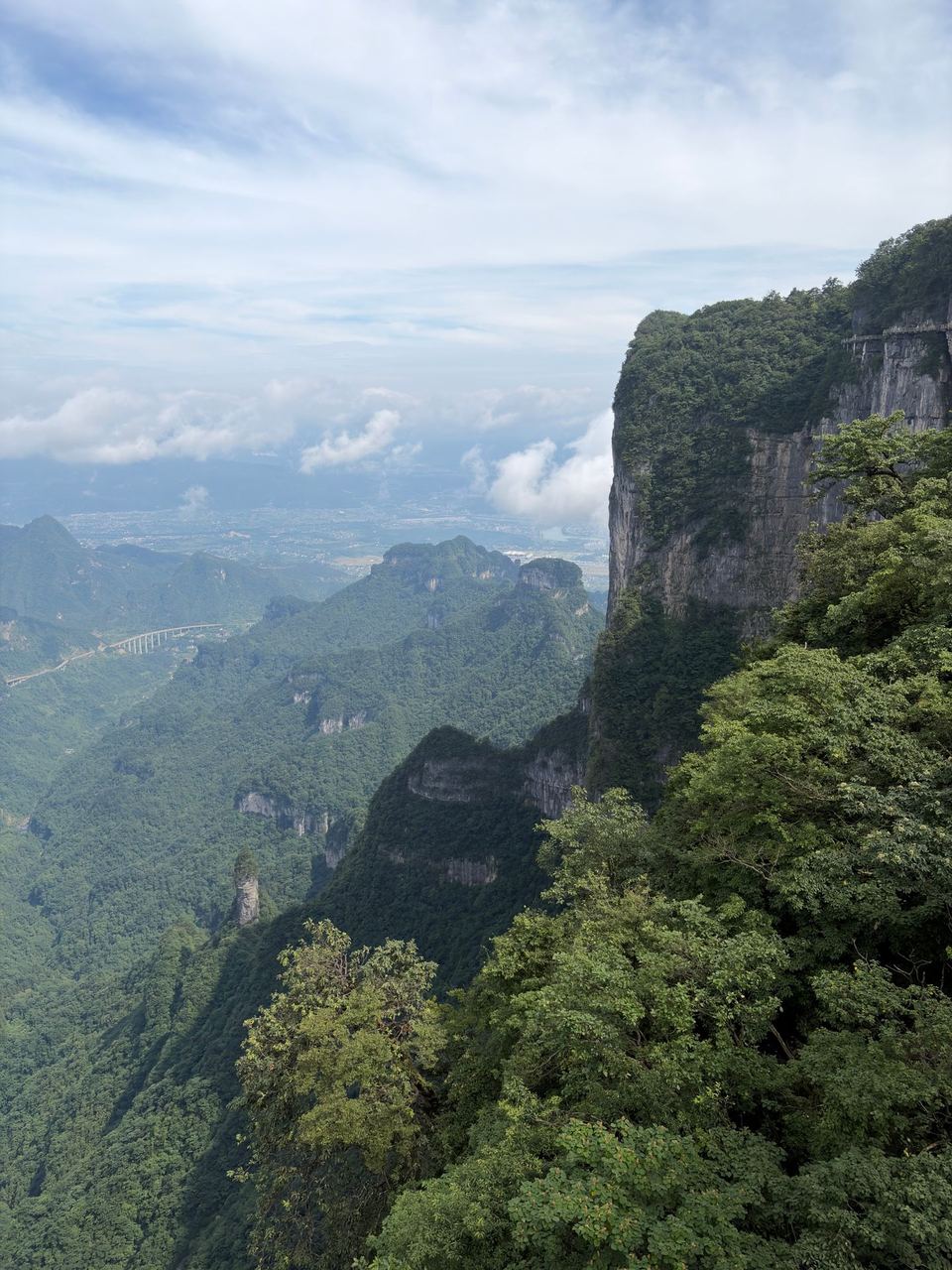
- West Line (~2.8 km) — the dramatic one. Cliff-hugging boardwalks over the city side, including the famous Guigu Plank Walk (鬼谷栈道): a walkway pinned to a vertical rock face with a very long way down on your left.
- East Line (~3.7 km) — gentler underfoot, more forest, views back to the arch, and the high viewpoint at Yuhu Peak.
- A short Middle Line (~0.85 km) links them past the summit high point at 1,518.6 m.
The full circuit takes most people three to five hours at a looking-around pace. If you only want the highlights, the West Line alone is about an hour.
Where the two loops meet, at Cherry Bay, is Tianmen Mountain Temple — a genuinely working Buddhist temple, rebuilt in the early 2000s, that keeps a Buddha relic brought from Lumbini in 2009. It is the calmest place on the mountain and almost nobody rushing between glass attractions stops there. Do stop there.
The glass walkways — all three, and why you can ignore them
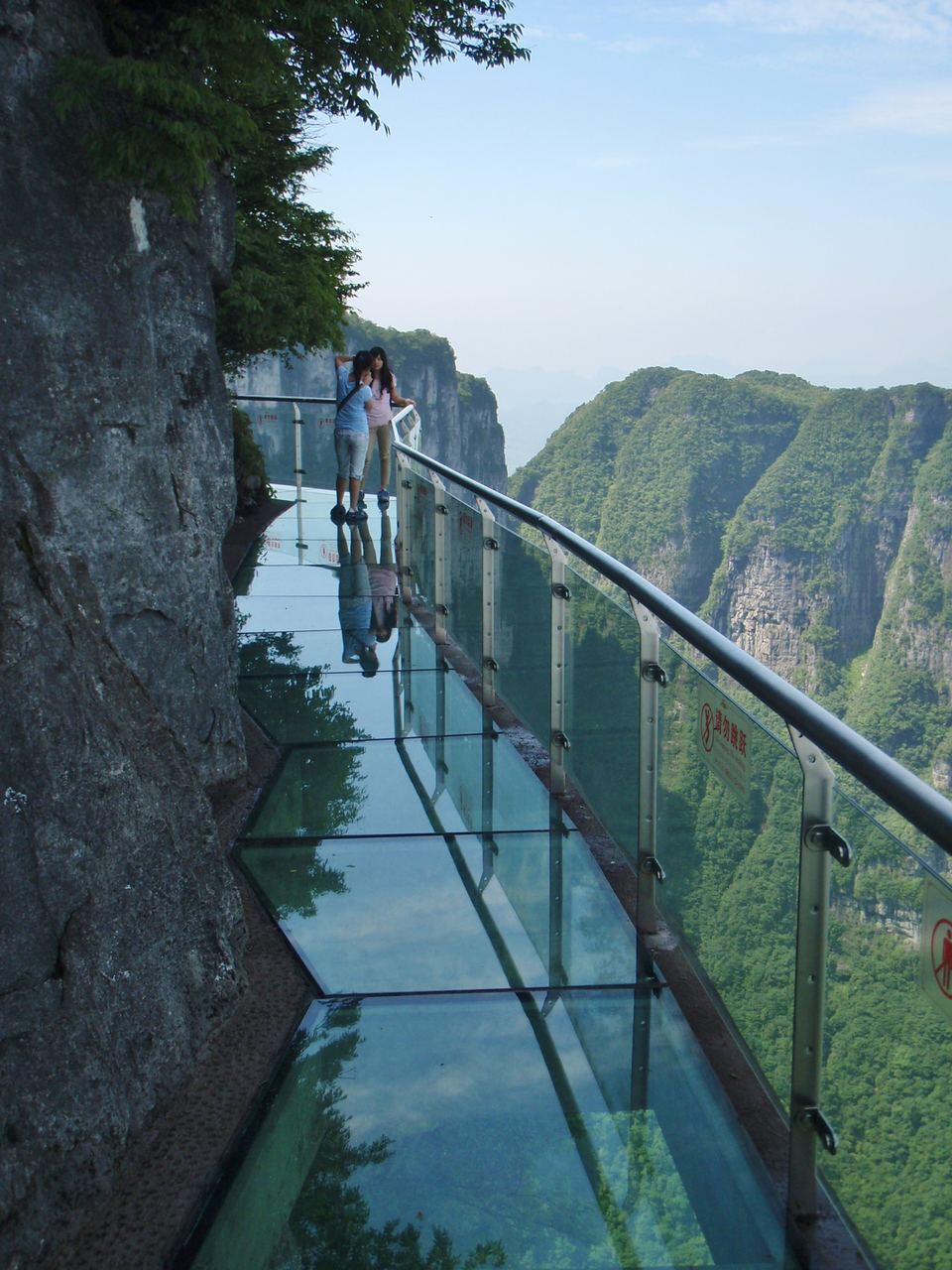
There are three glass sections, not one, and they are all short:
| Walkway | Length | Where |
|---|---|---|
| West Line glass walkway | 60 m | Highest of the three, near the Guigu Plank Walk |
| East Line glass walkway | 60 m | East loop |
| Coiling Dragon Cliff (盘龙崖) | 100 m | Opened 2016, looks down on the 99 bends |
Each one costs ¥5 for the mandatory cloth shoe covers, bought at the entrance to that walkway — and it’s ¥5 per walkway, not one fee for all three. Your own shoe covers won’t be accepted.
Now the useful part. None of them is on the through-route. Every glass section has an ordinary solid path running alongside or around it. You will not get stuck, you will not have to turn back, and you don’t need to buy anything to keep walking. The Guigu Plank Walk next to the West Line glass — the one that looks most alarming in photos — is a normal cliffside boardwalk with a solid floor, no extra ticket. It’s exposed, but you can see what you’re standing on, which for most people is the whole difference.
If you do want to try one: the walkways are wide, the glass is thick, there are steel edges to walk on, and the shortest way across is to keep moving and look at the far end. The people shrieking are having fun. It is fine to walk past all of it and let them.
Inside the mountain: the escalators
Between the summit and Tianmen Cave, the mountain is hollowed out by a chain of escalators — twelve flights, roughly 900 metres of tunnel, about 340 metres of lift.
They split into two groups, and this matters because the money is different:
- The upper seven flights (cave ↔ summit) are included in your ¥285 ticket.
- The lower five flights (cave plaza ↔ cave, the section that replaces the 999 steps) are ¥32 going up and free going down, about ¥16 for seniors.
It is a strange, brightly-lit, slightly sci-fi twenty minutes inside a wet limestone mountain, and for anyone with a fear of heights it’s the best-value part of the day: you gain or lose 340 vertical metres and never see the drop. Take it without guilt.
The 999 steps
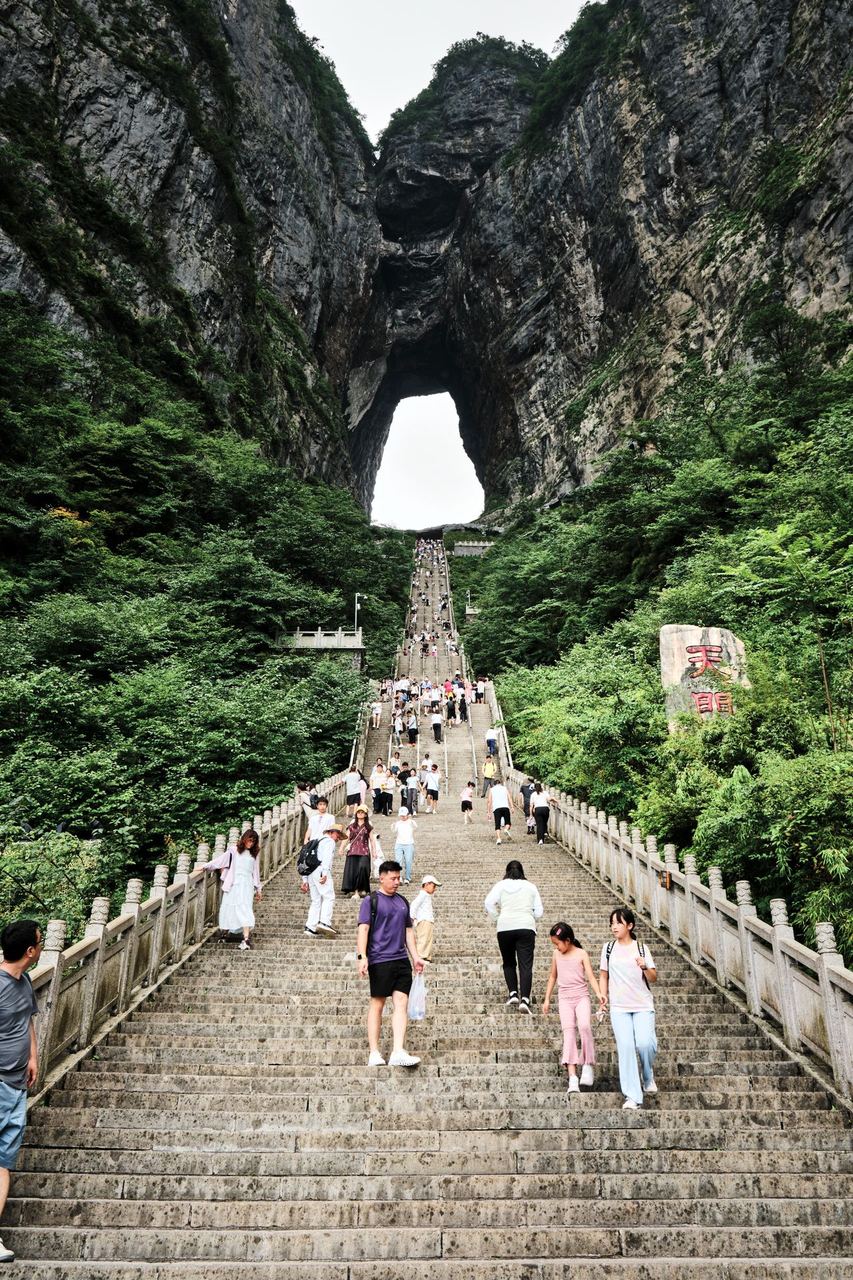
From the cave plaza, the Stairway to Heaven goes up to the arch in 999 steps — roughly 150 metres of climb, averaging 45 degrees and steeper than 60 in places, and about 30 minutes if you’re moving steadily.
The number is a piece of poetry rather than a survey. Nine is the lucky, long-lasting number in Chinese; 999 promises 长长久久, “for ever and ever.” Nobody is going to hand you a refund if you count 997.
Here’s the thing worth knowing: the steps are hard on your lungs, not on your nerves. You are climbing a staircase in a gully with the mountain on both sides — this is not an exposed section. If your problem is heights rather than fitness, this is one of the safer parts of the mountain. If your problem is fitness rather than heights, take the escalator up for ¥32 and walk down the steps instead, which is free and much easier on everything except your knees.
The hole itself
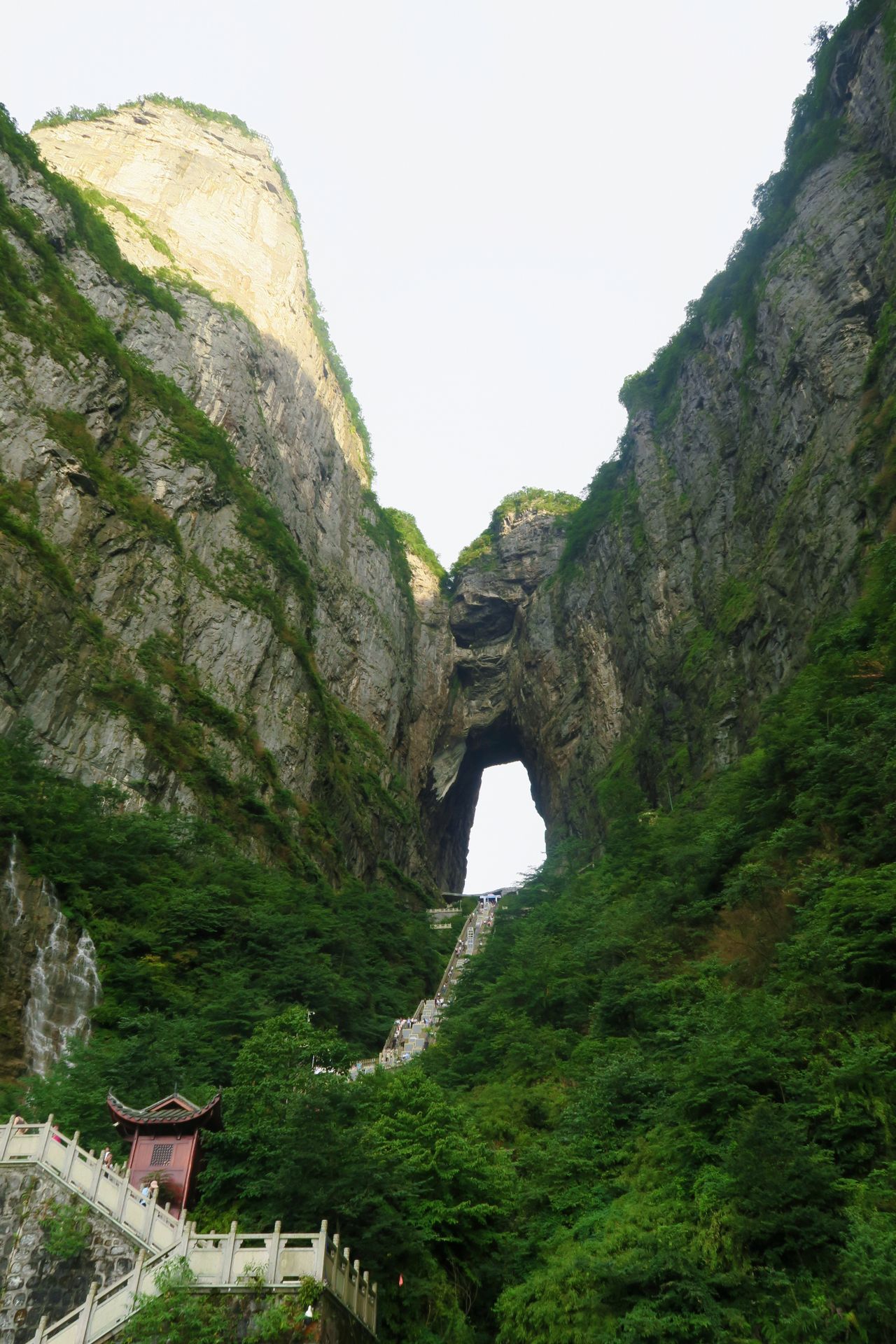
Tianmen Cave — 131.5 m high, 57 m wide, 60 m deep, at around 1,300 metres, and it goes straight through the mountain. Stand under it and there is sky on the other side.
The story is that in AD 263 the cliff face collapsed and opened the gap — recorded in the old chronicles, treated locally as the mountain’s founding event, and best repeated the way we’ve just done it: as what the records say, not as a geologist’s date.
What the arch has mostly attracted since is people trying to get through it at speed:
- 11 December 1999 — the Hungarian aerobatic pilot Péter Besenyei flew an Extra 300 through the arch, the first aircraft to do it. Several more pilots followed.
- 24 September 2011 — Jeb Corliss became the first person to fly through it in a wingsuit, at over 200 km/h. (These two are constantly muddled together: 1999 was a plane with an engine; 2011 was a man in a fabric suit.)
- 8 October 2013 — the Hungarian wingsuit pilot Victor Kovats died in a practice flight here when his parachute failed to open.
The arch has been used for stunts, races and world championships ever since, and it is worth standing under it for a minute with all of that in your head. It is a very large hole, and the sky through it looks fake.
The road with 99 bends
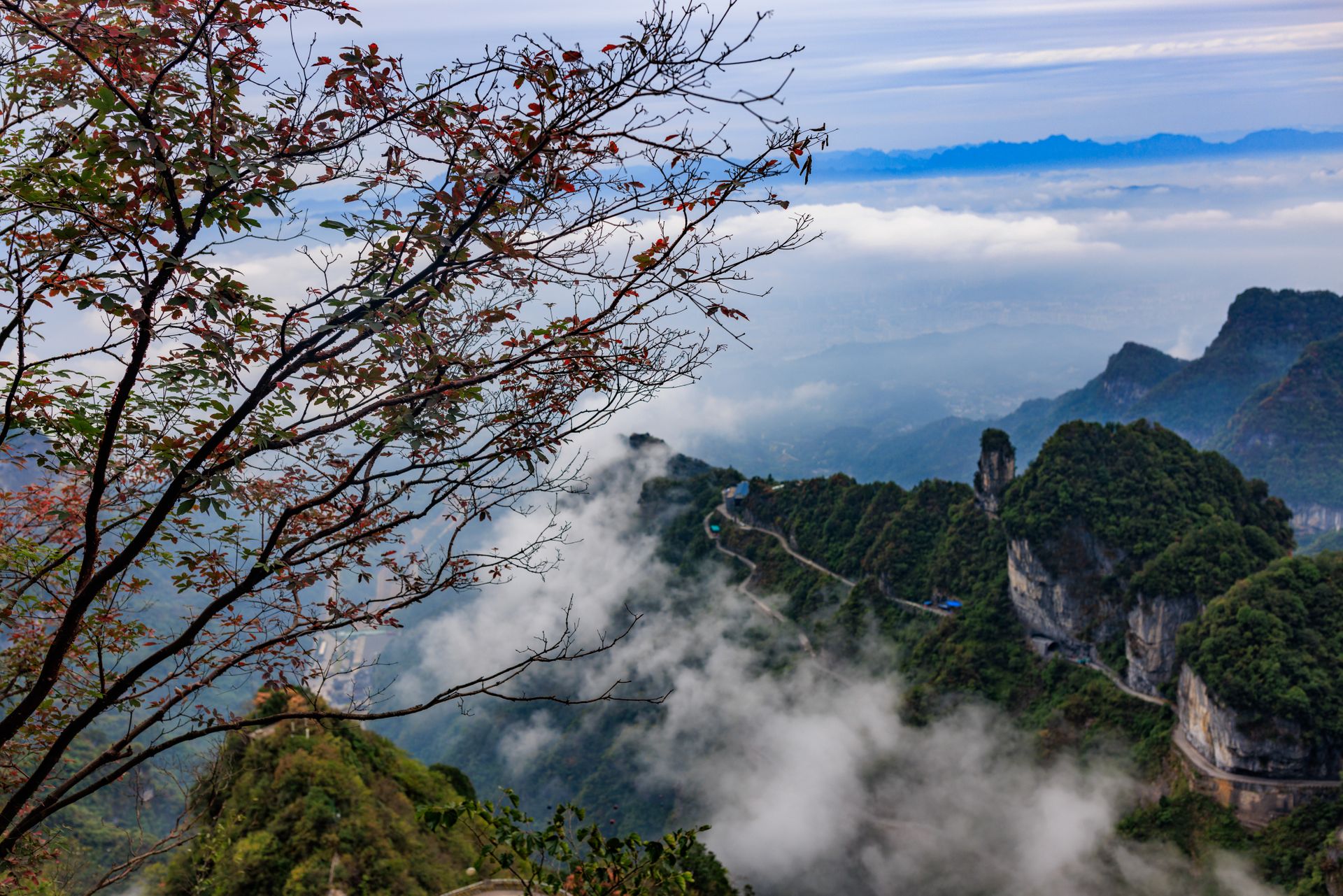
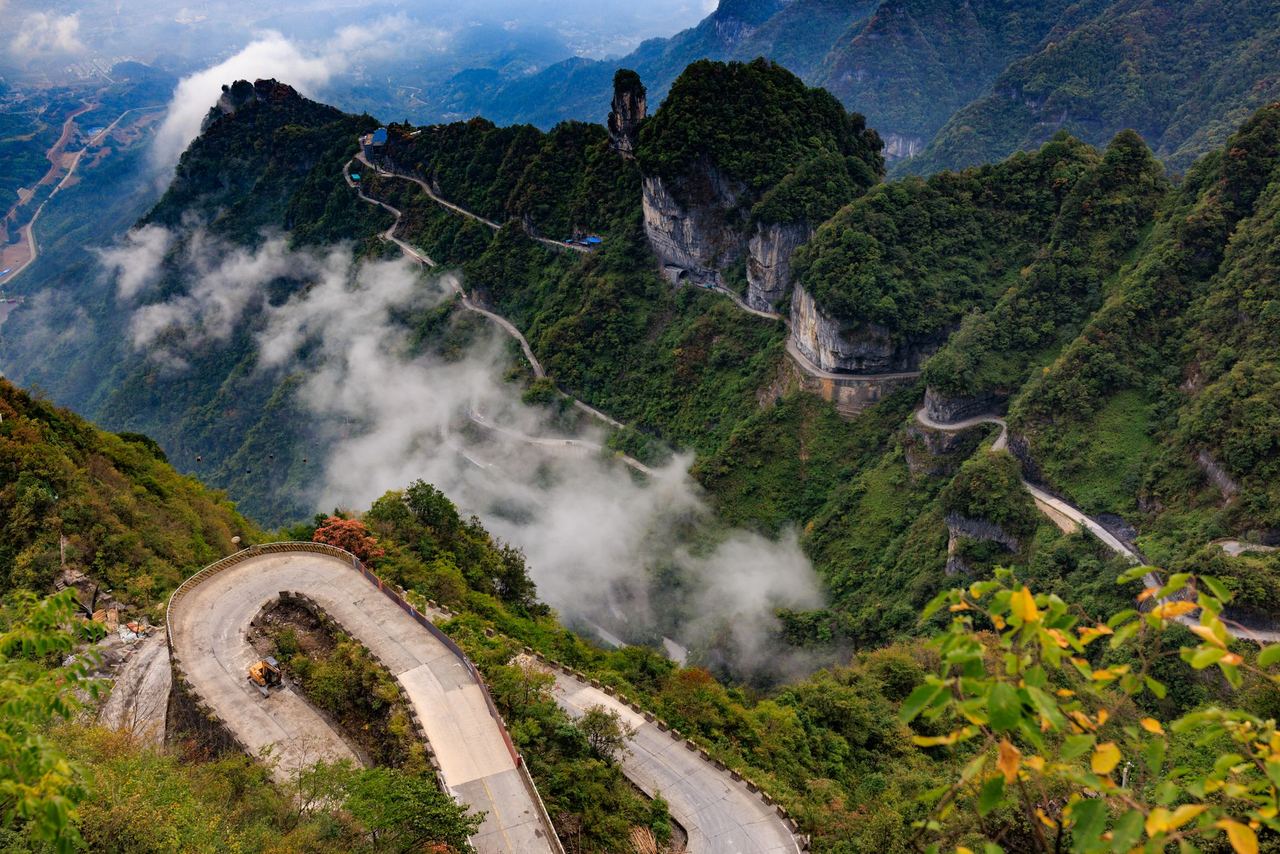
Tongtian Avenue — “the road to heaven” — climbs 10.77 km with 99 hairpins, from about 200 m up to 1,300 m at the cave plaza. You don’t drive it; a scenic-area shuttle does, and depending on your route you’ll ride at least part of it.
It’s spectacular from above and quite a lot to take in from inside the bus. Two practical notes: sit forward if you get car-sick, because the hairpins come one after another for twenty-odd minutes and there is nothing gradual about the gradient; and if you’re on the cable car instead, this road is what you’ll be looking down at through the floor.
Foreign visitors, for the record, cannot legally self-drive in China on a foreign licence, so the shuttle isn’t a choice you’re making anyway.
The vertigo map
The whole day, sorted by how exposed each bit actually is, and whether you can get out of it:
| Part of the day | How exposed | Can you skip it? |
|---|---|---|
| Big cable car (28 min) | High — glass box, 1,200 m of air, crosses the 99 bends | Yes — book Route C |
| Shuttle up the 99 bends | Moderate — road-level, but relentless hairpins | Yes, if your route uses the cable car instead |
| Escalators inside the mountain | None — you’re in a tunnel | No need |
| 999 steps | Low — a staircase in a gully, hard on lungs not nerves | Yes — escalator ¥32 up, free down |
| Standing under Tianmen Cave | None | — |
| Guigu Plank Walk (West Line) | High — cliff boardwalk, solid floor | Yes — ordinary summit paths bypass it |
| Glass walkways (×3) | High — that’s the point | Yes — all three have a solid path alongside |
| Summit forest paths, temple | Low | — |
Read that column on the right again. Roughly everything that frightens people here is optional. That is unusual, and it’s why we’d still send a nervous friend up this mountain.
When to go, and the clouds
Tianmen is in cloud more than 200 days a year. This is the single biggest variable in your day, and there’s not much you can do except accept it: some people ride up and see a white wall, some get the sea of cloud with peaks poking out of it that sells all the posters. Both are the same ticket.
- Spring (April–May) and autumn (September–October) are the sweet spot: mild, decent odds of a view, and the best light.
- Summer is hot, wet and busy, with afternoon thunderstorms.
- Winter is beautiful — rime ice on the summit forest — but this is the season that actually closes things. When it snows or ices up, the cave, the 99-bend road and the cave escalators can shut, leaving only the summit reachable by cable car. Glass walkways close for ice and heavy fog year-round.
The summit runs 5–10°C colder than the city, in every season. Bring a layer even in August; people arrive in shorts in July and buy fleeces at the top at scenic-area prices.
Tickets, times and queues
- Price: ¥285 adult, all three routes. Around ¥149 concession, ¥113 reduced, free under 14. If you see ¥278, ¥258 or ¥225 quoted online, those are old prices from before the November 2025 restructure — the number to budget is 285.
- Booking: real-name, timed-entry, online only in practice. Use the official WeChat account 张家界天门山景区 or the mini-program, and book with your passport number — you’ll scan the same passport at the gate, so bring the physical document. Numbers are capped daily; in peak season Route A can be sold out 5–10 days ahead.
- Hours: roughly 7:30–18:00 in high season, with last entry around 16:00; shorter in winter. Ask when you book — the seasonal date ranges move.
- Queues: the crush is 09:00–11:00, when a 20-minute wait becomes 1.5–2 hours. Being at the base station by 07:30 is worth more than any other trick on this page.
- How long you need: 5–7 hours for the full circuit; a half-day if you do the West Line highlights and go back down.
- Extra costs on top: ¥32 for the lower escalator going up, ¥5 per glass walkway, about ¥25 for the little forest chairlift on the summit. None of it is compulsory.
Getting there
- Zhangjiajie railway station (regular trains) is about 1 km from the cable car base station — a 15-minute walk.
- Zhangjiajie West (high-speed) is 9–10 km out: 15–20 minutes and about ¥20–30 in a taxi, or city buses. From Changsha it’s roughly 1 hour 45, from Chongqing about 2 hours; check 12306 for the day.
- Hehua Airport is 4–5 km from the base station, 10–15 minutes.
Because the cable car starts in town, you don’t need to stay anywhere special. A hotel near the railway station or the base station puts you in the 07:30 queue without a taxi ride.
Rules worth knowing before you’re told
- Drones are banned — the mountain sits in controlled airspace next to the airport, and most drones simply refuse to take off here.
- No smoking, no fire. This is a top-grade fire-protection forest area; lighters get collected at the gate, and fines apply outside the marked smoking points.
- Food and drink at the summit exist, at scenic-area prices. Bring water and something to eat.
- Wear grippy shoes. Wet limestone boardwalks, 999 steps and a lot of standing.
One last thing
The thing that stays with you about Tianmen isn’t the glass. It’s the moment on the cable car when the city goes out of sight underneath you and the mountain arrives all at once — no walk-in, no warm-up, just noodle shops and then, a few minutes later, a wall of rock with a hole in it that has been there since the Three Kingdoms.
You can do that with your eyes shut for the scary bits. The mountain doesn’t check.
Image credits
Photos via Pexels (Pexels License): the arch and stairway, visitors on the stairway, and the cliff-top building — Deimantas Viburys; the arch from below — Alisha Bai; cable cars in mist — fan mo; the view from the cableway — JC Terry; the 99 bends and the summit panorama — Guillaume Kremer; the winding road and cloud on the road — David Tran. Glass walkway photo — Raki_Man via Wikimedia Commons (CC BY 3.0).