Hangzhou: The Lake That Was Written
East
On this page
There’s a poem about this lake that every Chinese person can finish for you. It was written in 1073 by a man who was, at the time, a junior official posted to the city — and who came back sixteen years later to run it:
水光潋滟晴方好,山色空蒙雨亦奇。 欲把西湖比西子,淡妆浓抹总相宜。
The water glitters when the sun is out; the hills go strange and lovely in the mist. If I compare West Lake to Xi Shi — lightly made up or heavily made up, she is always beautiful.
淡妆浓抹总相宜 — “always beautiful, however she’s made up.” A thousand years later people still say it about a photograph, a room, a face. Which is the odd thing about arriving in Hangzhou for the first time: you have never been here, and yet your sense of what “beautiful” looks like already came from here. The willows leaning over the water. The arched bridge disappearing into fog. Tea terraces combed into a hillside. This is the city where those images were assembled and then shipped out to the rest of the world as the Chinese idea of scenery.
Here’s the secret, though. Almost none of it is natural.
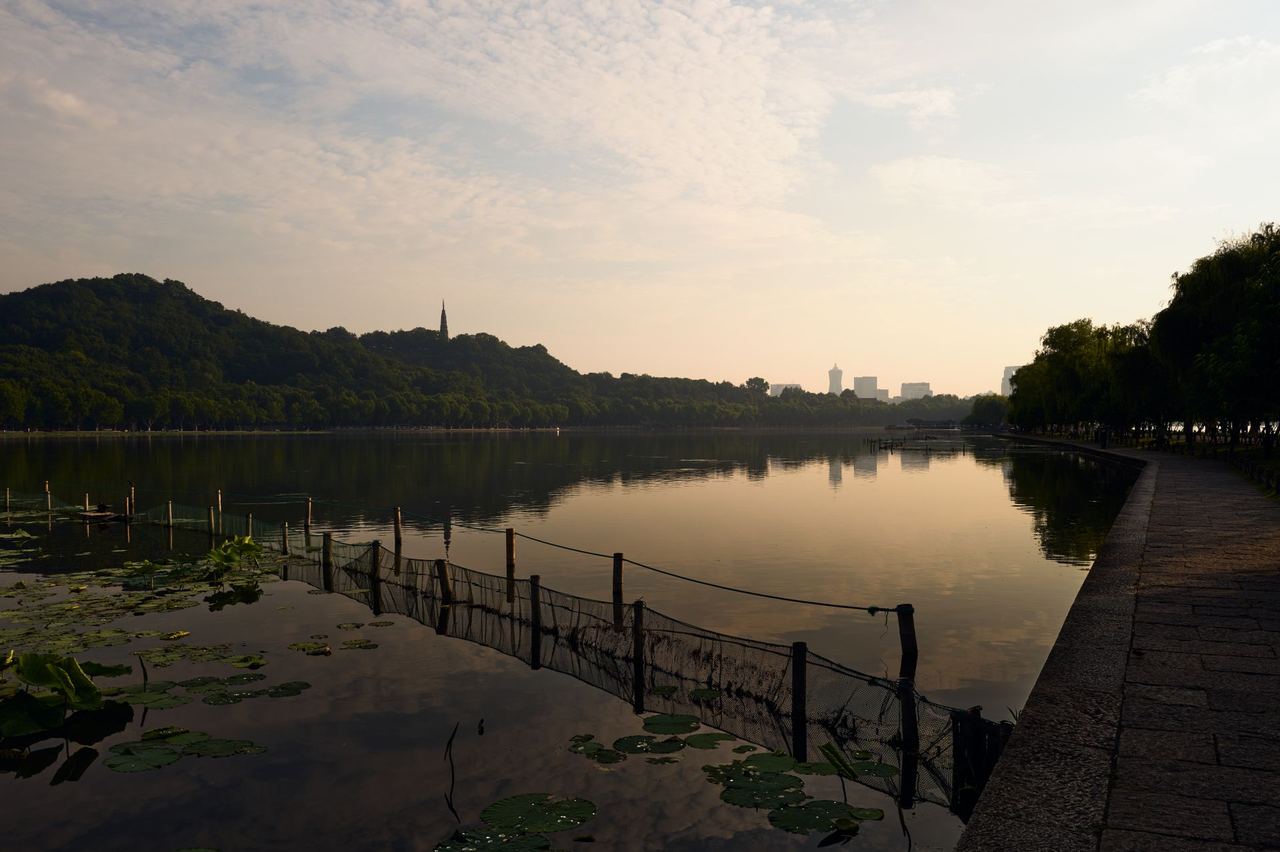
The lake was written, not found
Start with the thing most guides skip: West Lake isn’t a pretty lake that someone happened to put names on. It’s a lake that a thousand years of writing turned into a pretty lake.
The names came first. In the Southern Song dynasty, when the imperial court fled south and made this city its capital in 1138, the imperial painting academy moved in beside the water and was given the lake as a subject. What the painters produced wasn’t only pictures — it was titles:
苏堤春晓 Spring Dawn on the Su Causeway · 断桥残雪 Lingering Snow on the Broken Bridge · 雷峰夕照 Evening Glow on Leifeng Pagoda · 曲院风荷 Lotus in the Breeze · 平湖秋月 Autumn Moon over the Calm Lake · 柳浪闻莺 Orioles Singing in the Willows · 花港观鱼 Watching Fish at Flower Harbour · 南屏晚钟 Evening Bell at Nanping · 三潭印月 Three Pools Mirroring the Moon · 双峰插云 Twin Peaks Piercing the Clouds.
Ten scenes. Ten titles. And here’s what almost nobody tells you, because it’s more useful than it sounds: the Ten Scenes are not a checklist. They’re a timetable. Look at what’s actually in the names — spring dawn, lingering snow, lotus, autumn moon, evening bell. Every one of them is an instruction about when to be somewhere. The lake isn’t best at all times; it’s best at ten specific moments, and the painters wrote them down so you’d know which one you were walking into.
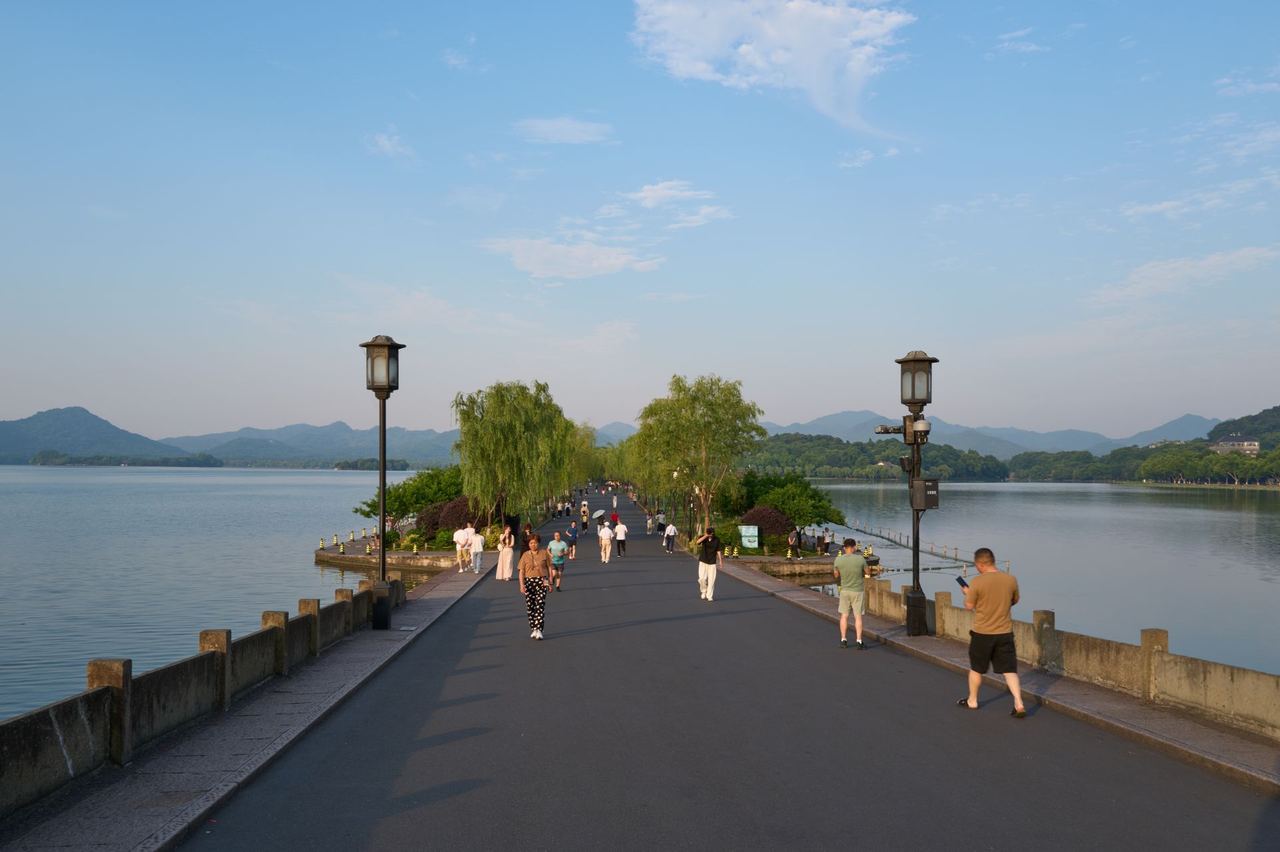
Then came the two men who built the lake. Bai Juyi (白居易) governed Hangzhou from 822 to 824 and had the lake dredged and a dyke raised to hold water for the fields. Two and a half centuries later Su Shi (苏轼) — the same poet who wrote the lines above — arrived as governor and found the lake two-thirds choked into a weed field. He petitioned the throne with an argument that is still quoted: Hangzhou without West Lake is like a person without eyebrows and eyes. He won, dredged it, and had the weeds and silt piled into a long north–south causeway with six bridges. That is 苏堤, the Su Causeway. He also set three stone pagodas in the water as boundary markers against illegal land reclamation — and those markers are where the name 三潭印月 comes from. (The three stones standing in the lake today are later replacements, but the name is his.)
So the best-loved thing in this city is a poem that requires annual maintenance. The loveliest walk in Hangzhou is made of the sludge of a lake that one poet saved from another poet’s neglect. Stand on it and it’s hard not to feel that the landscape is doing something landscapes usually don’t: trying.
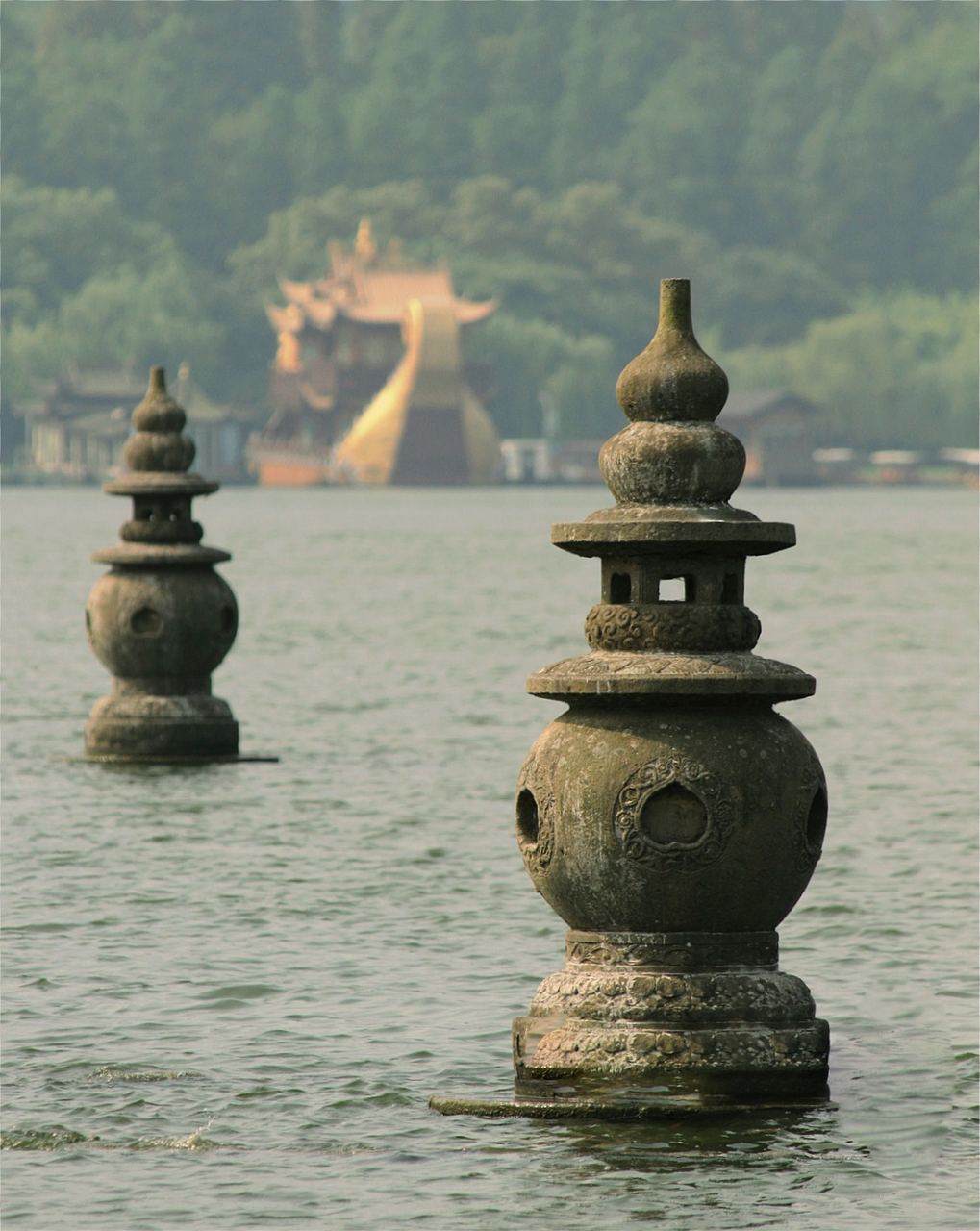
Each of those pagodas has five round openings, and that’s the “mirroring” in the name: on Mid-Autumn night, candles go inside them, and the light through the openings — doubled by the water — turns the whole bay into a sky full of moons.
And in October 2002, Hangzhou did something no other Chinese city had done. It tore down the walls. The lakeside gardens were unbundled from their ticket booths and opened 24 hours a day, free — the first top-tier 5A scenic area in the country to do it, and still the one that every other 5A area is quietly judged against. The city gave up around 200 million yuan a year in tickets and, mostly, got it back many times over. So: there are no gates at West Lake, no ticket, no closing time. If anyone offers to sell you a “West Lake ticket”, you’re being scammed. Which brings us to the one thing that is gated — and it isn’t the lake.
How to walk a poem
So what do you actually do with a lake that’s been curated for a thousand years? The short answer is that you stop treating it as a lap to be completed.
The mistake almost everyone makes: walking the whole shore. The lake is around 15 km round, and circling it on foot buys you a lot of pavement and a lot of the same view. Do what locals do instead — use the two causeways to cut across it, not to go around it. The Su Causeway (苏堤) runs about 2.8 km north–south with six bridges and willows the whole way; the Bai Causeway (白堤) is a short 1 km hop from the Broken Bridge over to Solitary Hill. Cross, wander, sit down, cross back somewhere else.
Then let the timetable do the work:
- 苏堤春晓 — Spring Dawn on the Su Causeway (late March–April, first light): the willows break, the causeway goes misty and pink, and the painters were right about it. This is the one worth setting an alarm for.
- 曲院风荷 — Lotus in the Breeze (July–August): the whole western shore fills with lotus.
- 平湖秋月 — Autumn Moon over the Calm Lake (October–November, after dark): the moon comes up over the water and the lake turns to glass.
- 断桥残雪 — Lingering Snow on the Broken Bridge (January–February, and only if it snows): the rarest of the ten, which is why it’s the most famous.
Two things that catch visitors out. Shared bikes are banned on the Su Causeway — there are staff at both ends, and you’ll be turned around; the causeway is the one place in Hangzhou where you walk. And on the water, use the official piers only (the state-run ones with the ticket windows) — the ferry out to Three Pools Mirroring the Moon and back runs around ¥55–70 and is the only boat you need. Anyone approaching you with a “private boat, good price” is selling you neither. Otherwise: no gate, no ticket, no closing time, open all night.
The mountain that flew here
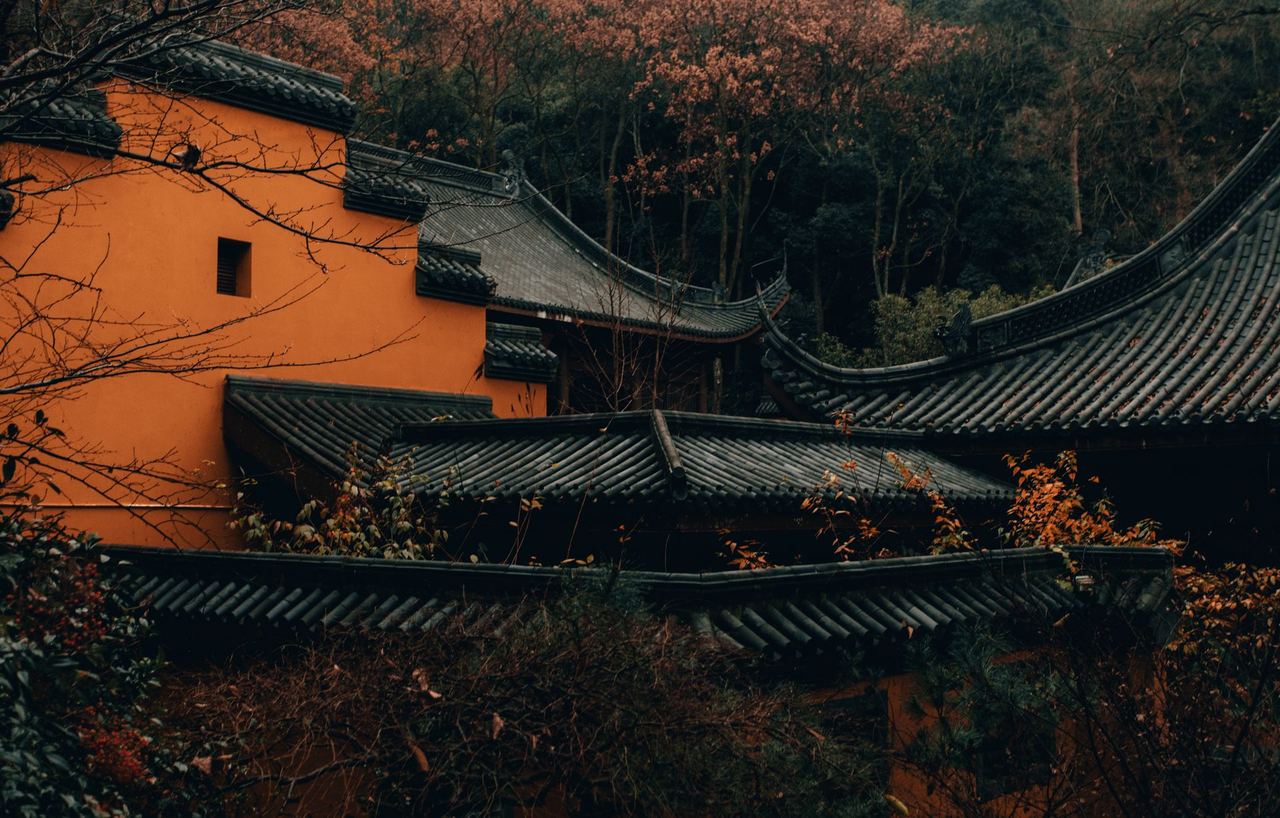
About five kilometres west of the water, the city goes dark and wooded, and you arrive at Lingyin Temple (灵隐寺) — which has a 2026 problem that is entirely a good problem.
First, why it matters. It was founded in 326 CE by an Indian monk named Hui Li (慧理), who looked up at the limestone peak beside the site and announced that this was a piece of India’s holy Vulture Peak that had flown over and landed here. The rock has been called 飞来峰 — the peak that flew here — ever since. Which means the temple turns 1,700 years old in 2026, putting it among the oldest continuously active Buddhist monasteries in China. It is also a Chan (Zen) temple, and in the 12th century it was home to Daoji, the mad, wine-drinking, meat-eating monk better known as 济公 (Ji Gong) — a figure so beloved that Chinese television has never really let him go.
The rock itself is the other reason to come. Feilai Feng is riddled with more than three hundred carvings cut straight into the cliff face between the 10th and 14th centuries, and art historians make the trip specifically for the Yuan-dynasty figures, which follow a Tibetan–Nepalese style found almost nowhere else in China. They sit in little arched niches, dark with moss and centuries, watching people file past.
Now the part that changed — and the reason so many guides online are wrong. On 1 December 2025, the Lingyin–Feilai Feng scenic area abolished its tickets entirely. The ¥45 entry for the rock and the ¥30 “incense flower” ticket for the temple itself — the ¥75 everyone writes about — are both gone. The whole area, including the neighbouring Yongfu (永福寺) and Taoguang (韬光寺) temples, is now free.
But free is not the same as open. Entry now runs on real-name, timed reservations, booked through the official mini-program “杭州灵隐飞来峰” inside Alipay or WeChat. You can book up to 7 days ahead; you cannot book on the day; and since February 2026 the on-site registration desks are closed — sold-out days are handled by an online waiting list instead. The rules have teeth: if you book and then don’t turn up without cancelling in time, it is logged as a no-show, and your first one suspends your booking rights for 30 days (60 for a second, 90 for a third). Caps are separate for weekdays, weekends and holidays, and popular dates do fill. For a visitor with a week in China, a careless no-show can cost you a booking you actually wanted — so book only the days you mean to use.
Practical shape of the visit: the area opens 7:30–17:30, last entry 17:00. The crush is brutal between 10:00 and 15:00 — go at opening, or after 16:00, and you’ll have the stone Buddhas more or less to yourself. Rain helps, too; wet stone and incense smoke is the version worth photographing. Modest dress (shoulders and knees), and note that most of the climb is uneven steps, not pavement.
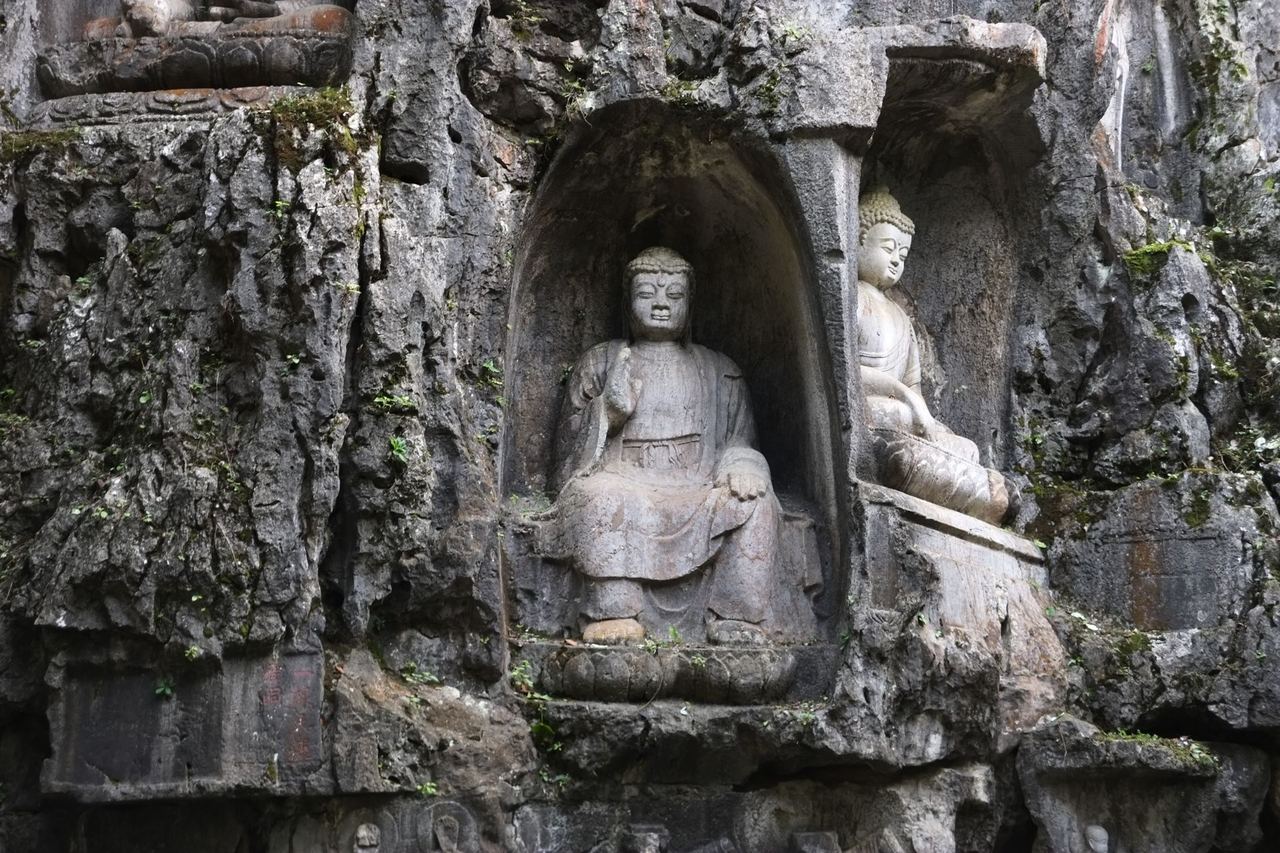
Two more honest notes. A ticket to the temple is not a ticket to a quiet temple — this is one of the most-visited religious sites in China, and on a holiday week the experience is closer to a queue than a sanctuary. And the free neighbours, Yongfu and Taoguang, sit higher up the same wooded valley, take far fewer people, and are frankly lovelier. If the main temple leaves you cold, walk twenty minutes further. For eating around here — the temple area is one of the best places in China to find proper Buddhist vegetarian food — see our vegetarian guide.
The pagoda with the snake under it
Southern shore. 雷峰塔, Leifeng Pagoda, sits on the hill of the setting sun, and it is the rarest kind of landmark: a building whose most famous occupant is fictional.
The story is 《白蛇传》, The Legend of the White Snake — China’s most retold love story. A snake spirit named Bai Suzhen takes human form, marries a man, and is imprisoned beneath this pagoda by the monk Fahai, who swears she will stay there until the lake runs dry. You will meet this story everywhere in Hangzhou: on stage, in shops, in the name of a bridge.
The bridge is 断桥, the Broken Bridge — where the two lovers first meet — and it is worth clearing up the name before you go looking for a broken bridge and can’t find one. Nothing about it is broken. After a snowfall, the snow melts on the sunny side of the span and stays on the shaded side; seen from a distance the bridge appears to be cut in two. That’s the whole joke, and it’s also why「断桥残雪」is a winter scene, not a description.
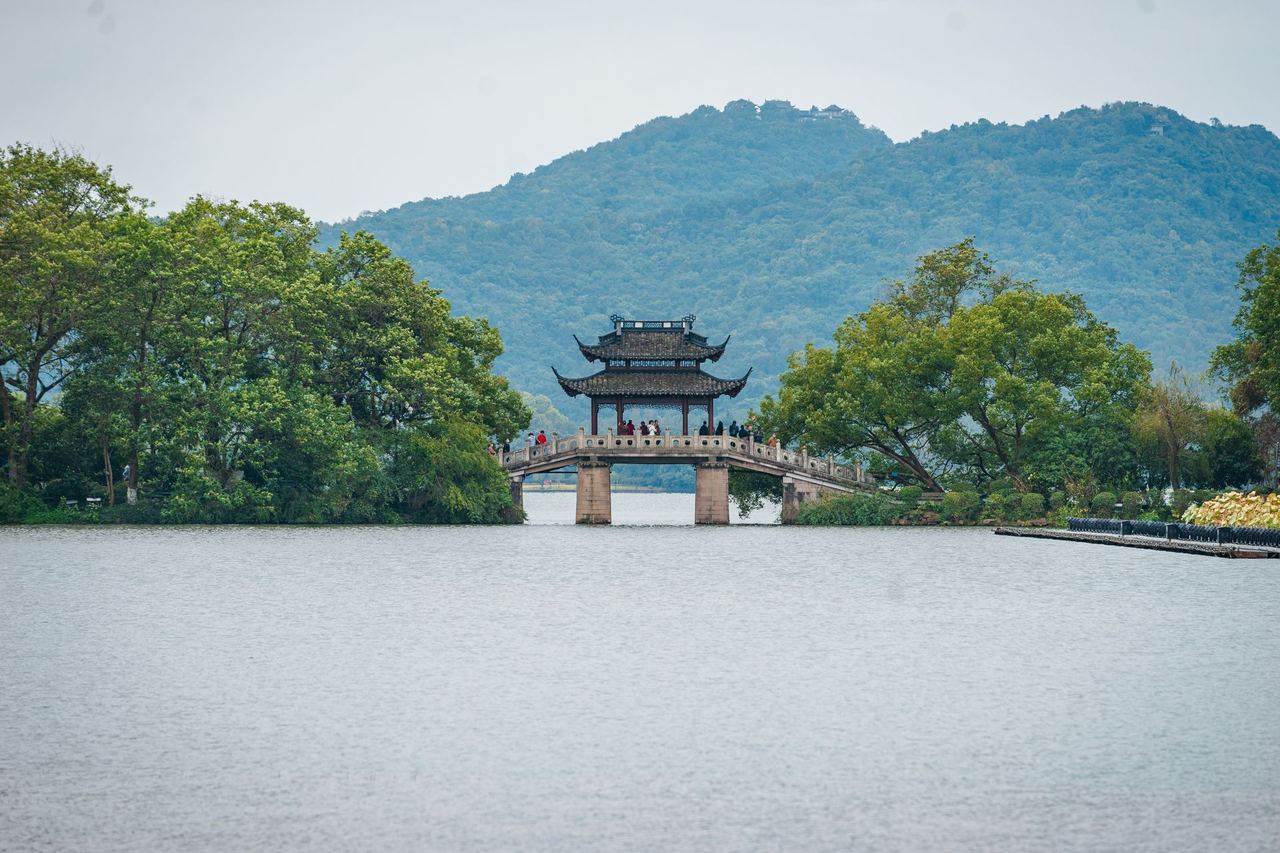
As for the pagoda: the original went up in 977, was burned out by raiders in 1555, and then spent its last few centuries being quietly dismantled by its own visitors. Popular belief held that its bricks warded off evil, helped you conceive a son, or made your silkworms thrive, and people took them home a brick at a time until, on 25 September 1924, the whole thing simply fell over. Lu Xun wrote two celebrated essays about it — both of them pleased. The pagoda that stands there now is a 2002 reconstruction, 71 metres of steel and copper, and it is honest about what it is: the base is glass, and you look straight down through the floor at the original foundations and the underground chamber beneath your feet. A tower built over its own ruins, with the ruins on display. ¥40 to go up, and the right moment is late afternoon — climb it around 16:30 and you get the “leifeng at sunset” view the poets named, and then the whole lake switching its lights on.
And the snake? In 2000–2001, archaeologists excavating before the rebuild opened the underground chamber. They found a silver Ashoka pagoda, a gilded bronze Buddha, and what is believed to be a relic of the Buddha’s hair. No Bai Suzhen. But you have to admit it’s a better answer than nothing.
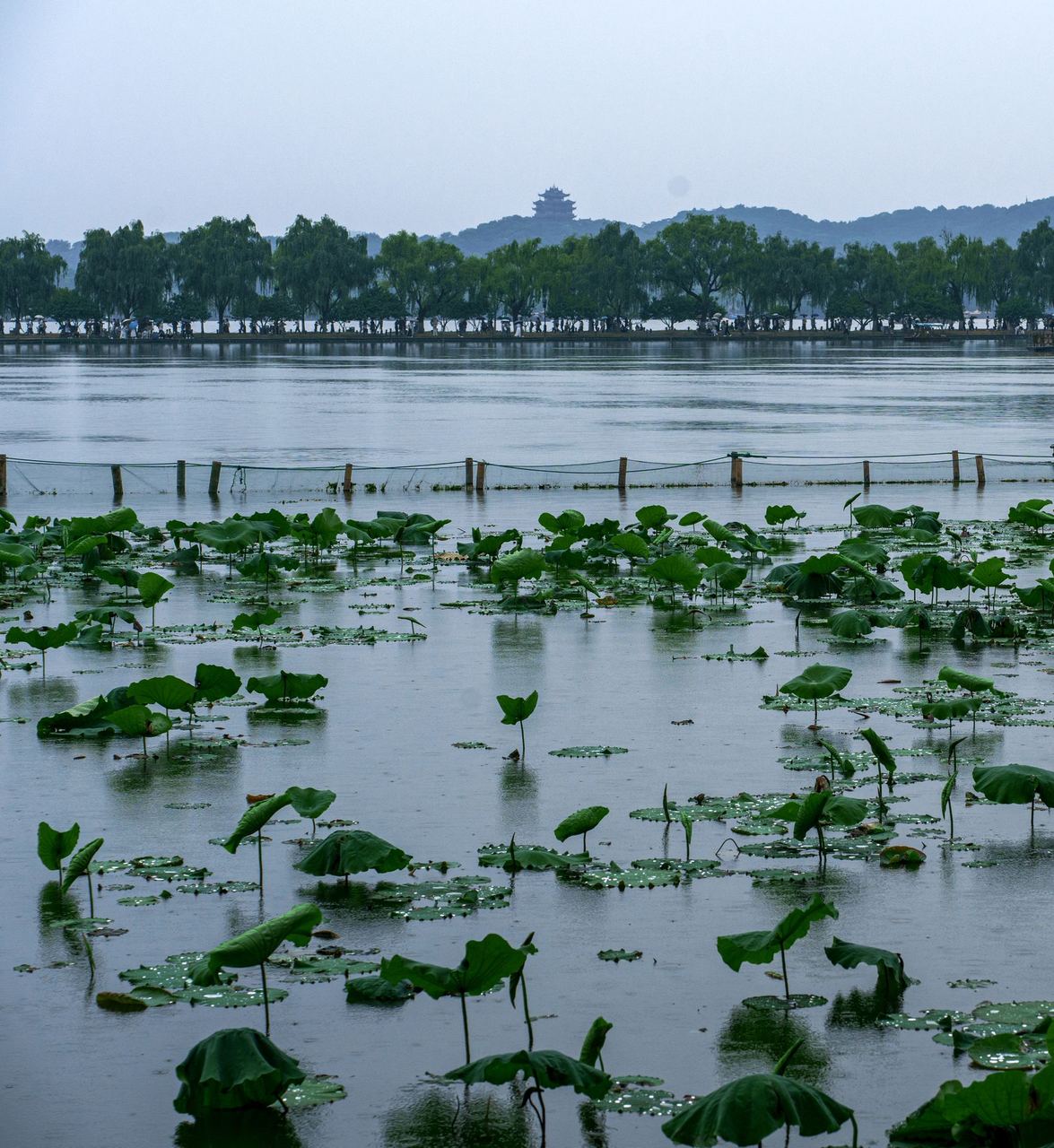
The tea, and how not to get had
West of the lake the city stops and the hills begin, and everything growing on them is 茶, tea. 龙井 — Longjing, “Dragon Well” is the most famous green tea in China and quite possibly the most counterfeited one on earth, and both facts are the reason to come.
Real West Lake Longjing comes from a small set of villages and slopes immediately west of the lake, traditionally grouped under five names — 狮 (Shifeng), 龙 (Longjing), 云 (Yunqi), 虎 (Hupao), 梅 (Meijiawu) — and nowhere else. Within that, price is set almost entirely by picking date: 明前茶, picked before the Qingming festival in early April, is the rarest and most expensive; 雨前茶, picked before around 20 April, is the one locals actually drink and, many will tell you, the better cup for the money.
The right way to do this is unglamorous and good: take a taxi to 龙井村 (Longjing Village) or 梅家坞 (Meijiawu), sit down at a terrace on the slope, and order a pot. You’re drinking tea grown on the hill you’re looking at, picked weeks or months ago, in the place it happened. That is the experience, and it costs a fraction of a box of the stuff at the airport.
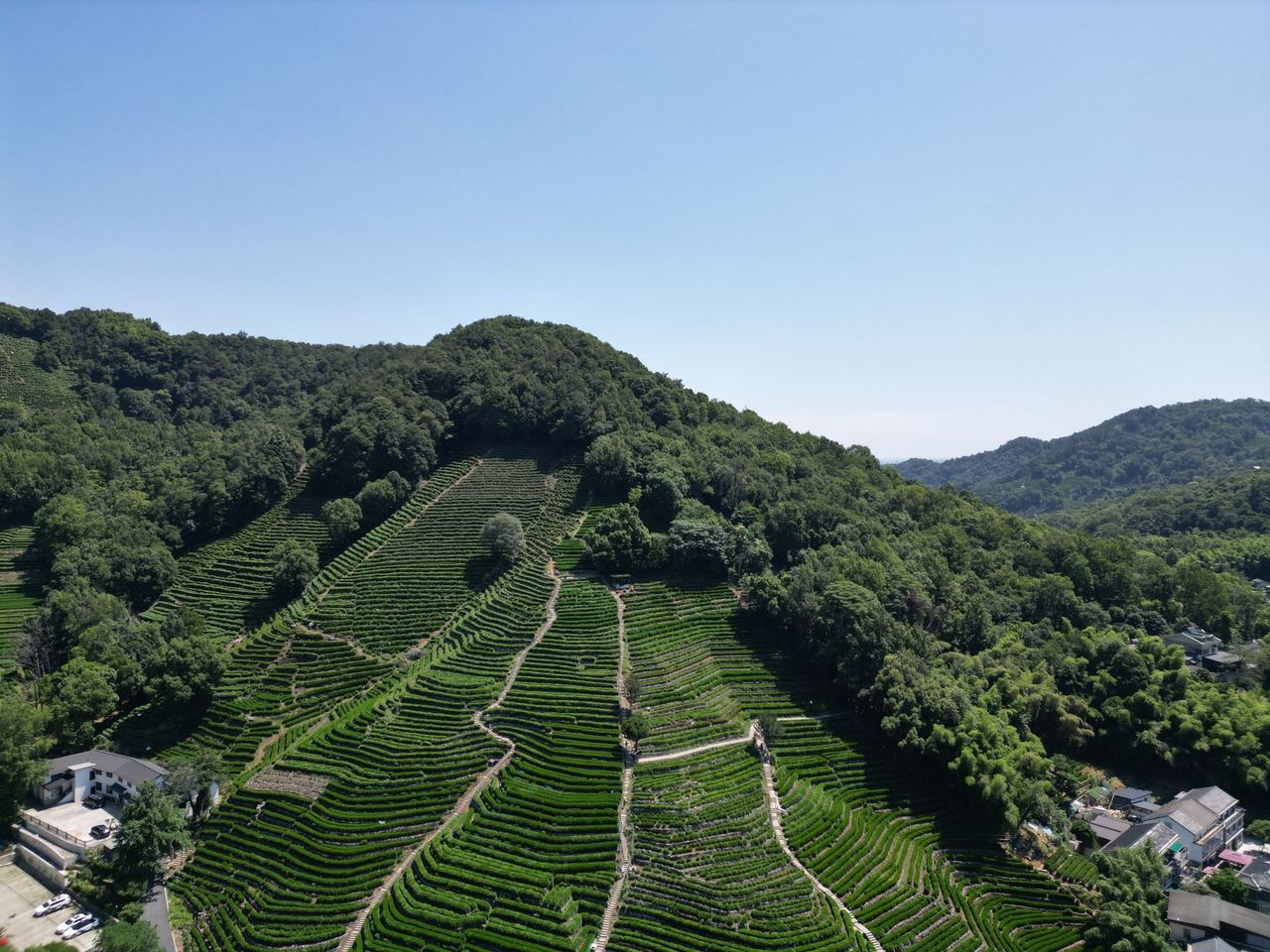
The one warning. Tea sold in shops around the lake, in the scenic area, and at the tourist end of every street is very often not West Lake Longjing — it is leaf grown in other provinces, pressed flat and pan-fired into the same shape. Real West Lake Longjing is a small harvest from a small area; the arithmetic doesn’t allow for the volume on sale. Two rules: buy from a grower whose fields you can see, and if the price is a bargain, it isn’t West Lake Longjing. This is not a scam in the criminal sense — it’s tea, and it’s drinkable — but you are not buying what the label says.
The other city: the canal
Here’s the thing tourists miss. Hangzhou is two cities stacked on top of each other, and the one everyone photographs is the newer one.
The lake made Hangzhou beautiful. The 京杭大运河 — the Grand Canal made it rich. This is the waterway that runs about 1,700 kilometres from here north to Beijing, first assembled in sections from the 5th century BC onward, and Hangzhou is its southern terminus — the port at the end of the line, where the grain of the south was loaded for the capital. Where the lake district is a poem, the canal district is a working town: 拱宸桥 (Gongchen Bridge), a single sweeping stone arch from 1631, and behind it the restored canal-side lanes of 小河直街 and the 桥西历史街区, where the whitewashed houses are real homes rather than exhibits, and the neighbours you’ll walk past are hanging out washing.
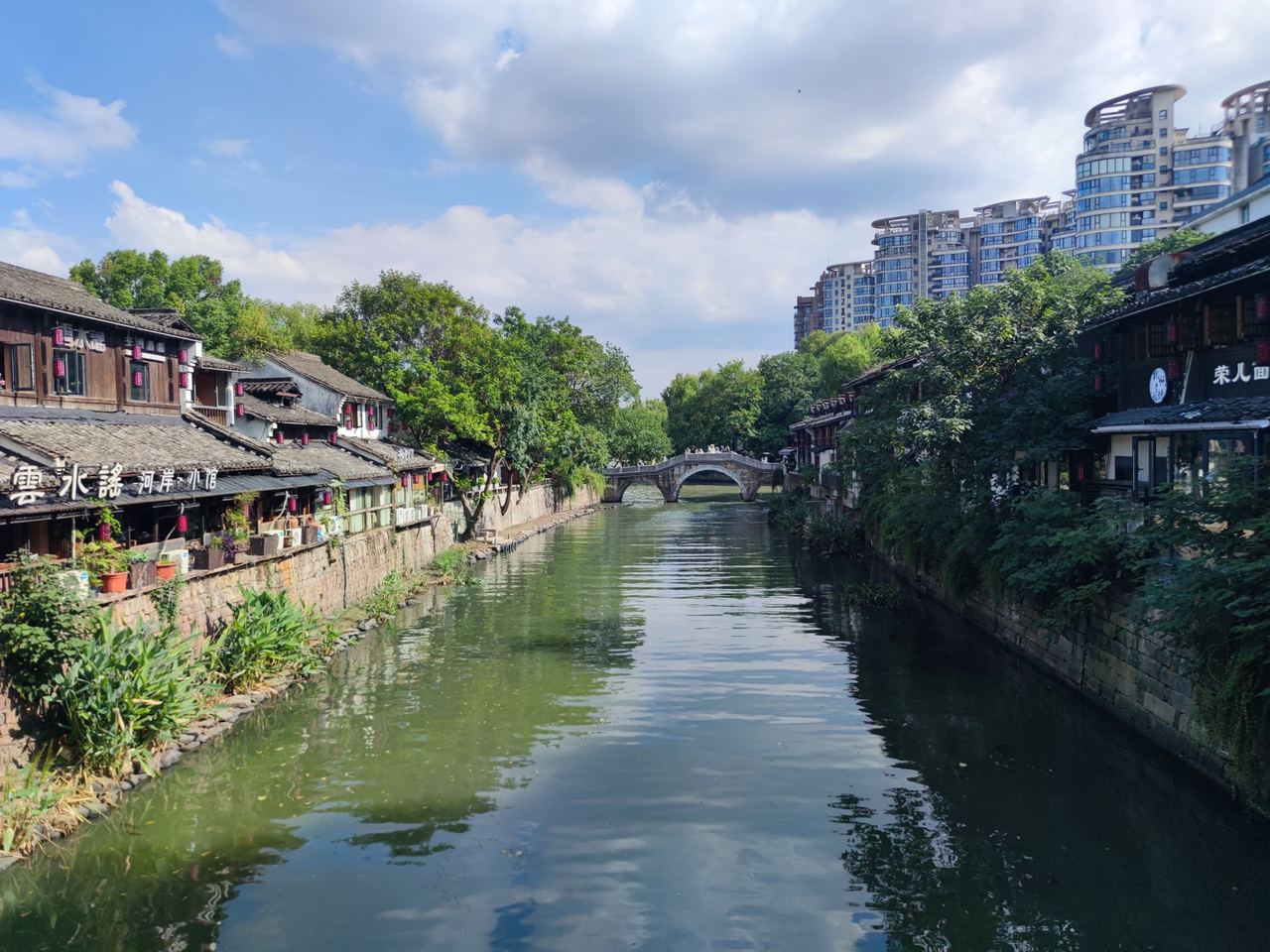
If you want one more layer of the city, it’s the one under the shopping streets: 南宋御街, the Southern Song imperial avenue, still a wide paved road running north from the old palace area, in a city that was the capital of China’s most sophisticated dynasty and has been trading with the world ever since. And if Hangzhou’s lake-plus-tea-plus-temple combination is leaving you wanting more classical Chinese scenery, its old proverb-partner is one hour away by train — “above, there is heaven; below, Suzhou and Hangzhou.”
Eat what the lake taught the country
Hangzhou cooking is the quiet, sweet, freshwater branch of Chinese food — the cuisine of a wealthy city that preferred refinement to fire. Two dishes you already know the name of, and one you should probably skip.
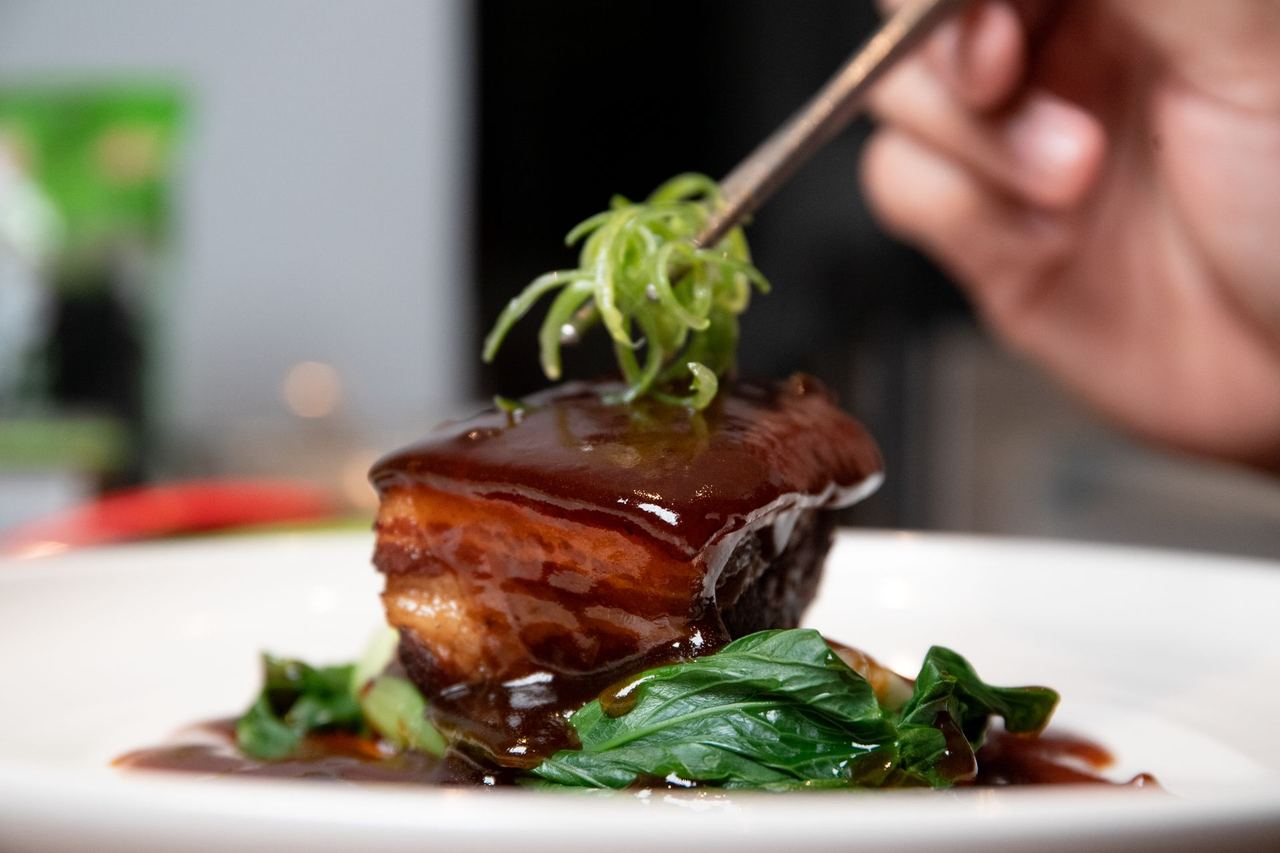
东坡肉 (Dōngpō ròu), Dongpo pork — a cube of pork belly, skin on, braised for hours in soy, sugar and Shaoxing wine until it’s a dark, wobbling lacquer you can cut with a spoon. The name belongs to Su Shi, who is also called Su Dongpo; the story goes that when he finished dredging the lake, grateful locals sent him pork, and he had it slow-cooked and handed back to the workers who’d done the digging. One cube is plenty. Two is a decision.
龙井虾仁 (Lóngjǐng xiārén), Longjing shrimp — river shrimp stir-fried with fresh tea leaves. Light, faintly bitter, seasonal, and the most elegant thing on most menus.
And 西湖醋鱼 (West Lake vinegar fish), which we’ll be straight with you about: it is Hangzhou’s most divisive dish. It is a freshwater fish under a sweet-sour sauce, and the traditional preparation poaches it only briefly, so the flesh stays soft in a way many foreign palates read as undercooked — on top of which grass carp has fine bones throughout and a muddy note if it wasn’t handled well. Locals order it out of loyalty. If you have one dinner in Hangzhou, spend it on the shrimp and the pork instead.
For the everyday version: 片儿川 (piàn’érchuān), the city’s own noodle — pickled greens, bamboo shoots, sliced pork, in a bowl for around ¥20 — is what Hangzhou actually eats for breakfast. 知味观 is the old institution for a sit-down version of everything above; 新丰小吃 is the cheap local chain that does the same food for a third of the price. On 河坊街, get a 葱包桧, a scallion-and-crisp pancake pressed flat and griddled for a few yuan, and eat it walking. For the full picture on menus, ordering and dietary needs, our guide to eating in China covers the mechanics.
Why you came
The honest practical close, because we’re still the friend who wants the trip to work.
Hangzhou has one airport, Xiaoshan International (HGH), about 30 km east of the lake, with metro and high-speed links into town. Its main rail hub is 杭州东站 (Hangzhou East), with 杭州西站 (Hangzhou West) handling a growing share of services. And the single easiest way to add Hangzhou to any China trip is from Shanghai: around 45–60 minutes by high-speed train between the two city centres, running all day. If you’re travelling on the country’s 240-hour visa-free transit, Hangzhou Xiaoshan is a designated port of entry, and the permitted stay area is Zhejiang province — good for the lake, the tea and the canal, so check your eligibility with our visa calculator before you book. Sort payment and data before you fly the way you would anywhere in China; the metro takes the same scan-and-ride codes you’ll have set up, and the high-speed rail guide covers booking with a foreign passport.
When to come: late March to May, when the tea is picked and the causeways are in blossom; and late September to November, which brings osmanthus, clear air and maples, and is the better-tempered of the two. July and August are hot, humid and typhoon-prone. Avoid the National Day week in early October and Chinese New Year unless crowds are the point — and if you do come in snow, go and stand on the Broken Bridge, because that’s the one day it makes sense.
But the real reason you came is simpler than any of this. You came because somewhere in the last thousand years, a painter named ten moments, two poets argued about a lake’s eyebrows, and a city decided that the most beautiful thing it owned should not have a gate. West Lake is free, the poem is a millennium old, and the ticket office closed in 2002. Go and read it.
Image credits
All photos via Pexels (Pexels License): West Lake at dusk and the lakeside causeway — CK Seng; the Broken Bridge — Ninh Tien Dat; Leifeng Pagoda in the rain — JUNLIN ZOU; Three Pools Mirroring the Moon — Anthony Tuttle; Lingyin Temple — Egg thing; Feilai Feng carvings — mingche lee; Longjing tea terraces — Amber Peng; the Grand Canal — 强 王; Dongpo pork — AMANDA LIM.