Eating Halal in China: Where to Find Muslim-Friendly Food
On this page
Good news for Muslim travellers: China is home to around 23 million Muslims, and halal food is easier to find than you’d expect — you just need one word to unlock it: 清真 (qīngzhēn), meaning “halal.” This guide is about where to find halal food: the noodle chain in every city, the Muslim districts worth a visit, and the dishes worth ordering — plus how to avoid the non-halal things that can hide in an ordinary Chinese menu.
The word that unlocks everything: 清真 (qīngzhēn)
In Chinese, 清真 literally means “pure and true,” and it is the standard word for “halal” and everything Muslim. A halal restaurant is written 清真餐厅 (qīngzhēn cāntīng). How to spot one from the street:
- Usually a green sign with the two characters 清真 — green is traditionally linked with Muslims in China.
- The Arabic word حلال (halal) or a crescent-and-star logo on the front.
- Most halal restaurants are run by Hui (回族) Muslims, China’s largest Muslim minority. Alongside them are other Muslim groups (the Uyghur 维吾尔族 and more), concentrated in the northwest.
Quick rule: if you see a green sign with 清真, the food is halal. If you don’t, assume it isn’t and ask.
The reliable option everywhere: Lanzhou lamian (兰州拉面)
If there’s one halal meal you can find in any city or small town, it’s Lanzhou beef noodles (兰州牛肉面 / 兰州拉面) — hand-pulled noodles in a clear beef broth, with slices of beef, coriander, and a little chilli oil. The shops are run by Hui or Dongxiang Muslim families, and the food is halal by default almost everywhere.
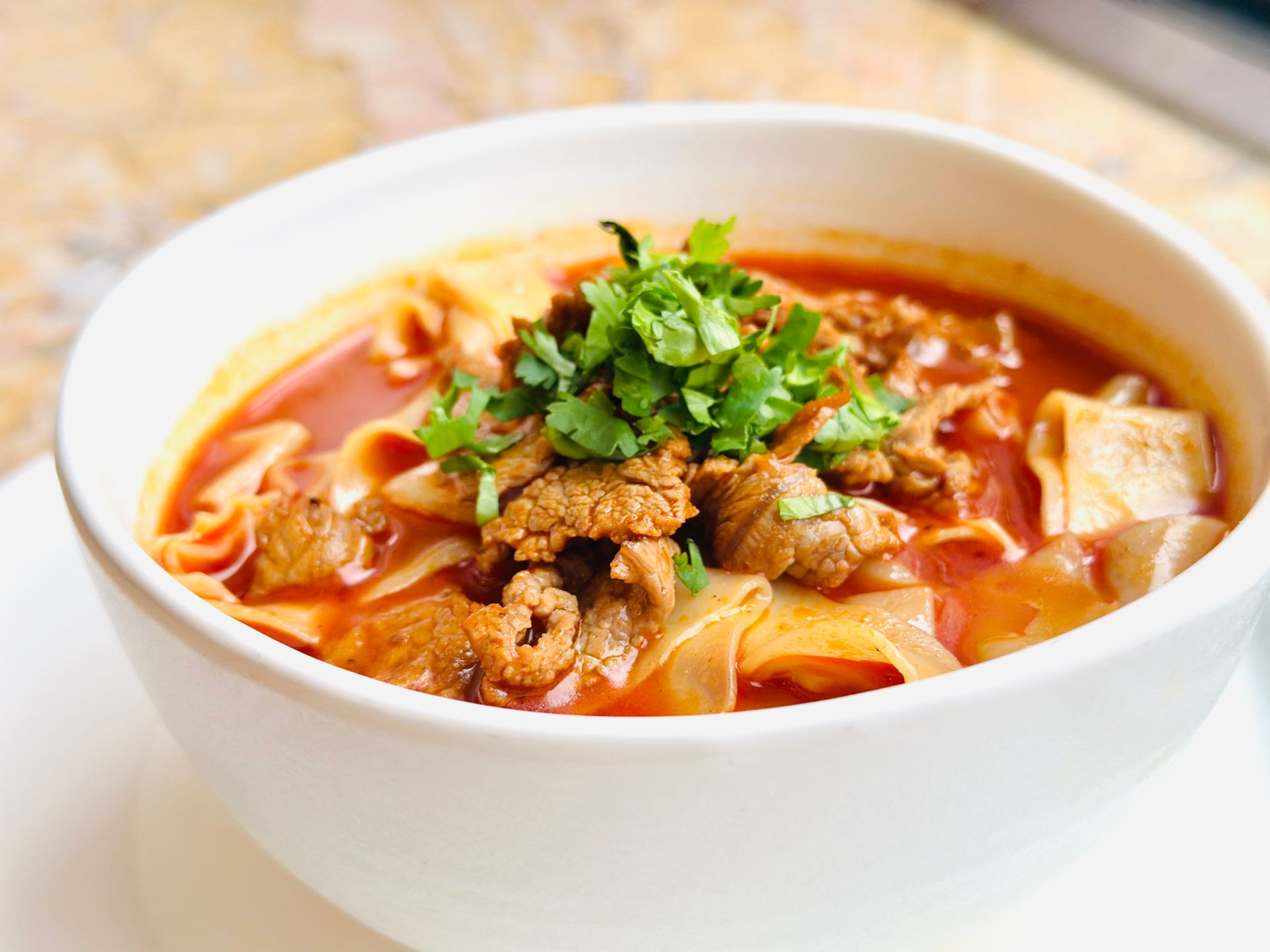
Remember the name: 「兰州拉面」. At almost any restaurant with this name, you can eat without worry.
Where halal food concentrates: districts worth visiting
Xi’an — the Muslim Quarter (回民街 Huímín jiē)
The most famous halal district in China, right behind the Drum Tower in Xi’an — a web of food streets that has fed travellers since the days of the Silk Road, when Muslim merchants settled here and stayed. The rule here: no pork, everything halal. Try the crumbled-flatbread lamb soup (羊肉泡馍), grilled skewers (烤串), soup dumplings (灌汤包), and persimmon cakes (柿子饼). For the full run-down, see the Xi’an guide.
Beijing — Niujie (牛街 Niújiē)
Beijing’s historic Muslim quarter, next to the Niujie Mosque (牛街清真寺), one of the oldest in the city. A quiet, uncrowded halal food street.
The Hui heartland in the northwest: Lanzhou / Yinchuan / Xining
Heading west, the provinces of Gansu, Ningxia and Qinghai are home to the Hui Muslims. In Lanzhou (home of the beef noodles), Yinchuan (capital of Ningxia) and Xining (gateway to Tibet), halal options are the default rather than the exception.
Xinjiang — Uyghur cuisine (Urumqi and Kashgar)
Uyghur cuisine is an entirely halal tradition — lamb and beef, and no pork at all. Its signature dishes are worth the trip alone: dapanji (大盘鸡), a big plate of spicy chicken; polo pilaf (抓饭); samsa (烤包子), oven-baked meat buns; and nan bread (馕). Try them in Urumqi or Kashgar, or at Uyghur restaurants found in most big cities.
Halal dishes worth knowing by name
| Dish | Chinese | Pinyin | What it is |
|---|---|---|---|
| Lanzhou beef noodles | 兰州牛肉面 | Lánzhōu niúròu miàn | Hand-pulled noodles in a clear beef broth |
| Lamb skewers | 羊肉串 | yángròu chuàn | Grilled skewers, the sound of the halal streets |
| Dapanji | 大盘鸡 | dàpánjī | A big plate of chicken with potatoes and peppers (Xinjiang) |
| Polo / pilaf | 抓饭 | zhuāfàn | Rice cooked with lamb and carrots (Xinjiang) |
| Crumbled-flatbread lamb soup | 羊肉泡馍 | yángròu pàomó | Crumbled flatbread in a rich lamb soup (Xi’an) |
| Samsa | 烤包子 | kǎo bāozi | Oven-baked meat buns (Xinjiang) |
| Nan bread | 馕 | náng | Round oven-baked bread (Xinjiang) |
| Laghman | 拉条子 | lātiáozi | Thick hand-pulled noodles (Xinjiang) |
What can slip through: hidden non-halal
In an ordinary Chinese restaurant, these are the things that make a dish non-halal even when it looks harmless:
| Hidden ingredient | Chinese | Where it appears | How to avoid it |
|---|---|---|---|
| Pork | 猪肉 | Many meat dishes, dumplings and fillings | Ask for 不要猪肉 (no pork) |
| Lard | 猪油 | Used for frying in many cuisines | Ask for 不要猪油 (no lard) |
| Meat stock | 肉汤 / 高汤 | Vegetables and soups are often cooked in stock | Ask for 不要肉汤 (no meat stock) |
| Cooking wine | 料酒 | Added to marinades and braises in most meat and fish dishes | Ask for 不要料酒 (no cooking wine) |
| Shaoxing wine | 黄酒 | In marinades and stews | Ask for 不要黄酒 (no Shaoxing wine) |
| Non-halal meat | 非清真肉 | Beef, lamb or chicken from a non-halal source | Ask 这是清真的吗? (is this halal?) |
| Blood | 血 | Dishes like blood tofu (血豆腐) | Avoid dishes containing 血 |
Note the difference from vegetarian: meat is allowed (beef, lamb, chicken) — what matters is that it is slaughtered halal and from a halal source. So the problem is not meat itself, but pork, alcohol, and anything cooked with them.
Phrases to show
Save these as a note or screenshot. Showing the Chinese is more reliable than pronouncing it.
| What you need | Chinese | Pinyin |
|---|---|---|
| I am Muslim | 我是穆斯林 | wǒ shì mùsīlín |
| I eat halal food | 我吃清真食品 | wǒ chī qīngzhēn shípǐn |
| No pork | 不要猪肉 | bú yào zhūròu |
| No lard | 不要猪油 | bú yào zhūyóu |
| No alcohol | 不要酒 | bú yào jiǔ |
| No cooking wine | 不要料酒 | bú yào liàojiǔ |
| Is this halal? | 这是清真的吗? | zhè shì qīngzhēn de ma? |
| Is there a halal restaurant nearby? | 附近有清真餐厅吗? | fùjìn yǒu qīngzhēn cāntīng ma? |
In a busy place, the most useful line is 「我是穆斯林,我吃清真食品」 — “I am Muslim, I eat halal food.” If there’s no halal restaurant nearby, order a vegetable dish with no meat stock and no cooking wine as a temporary fix.
Scene-by-scene pitfalls
Hot pot. The shared broth may contain pork, lard or alcohol. Choose a halal hot pot (清真火锅) or ask for a clear broth confirmed to have no pork and no alcohol.
Street food. Grilled skewers may be pork. Look for the 清真 sign or ask “这是清真的吗?” (is this halal?). Take hot, freshly cooked food.
Group meals. Dishes are placed in the middle and shared. Ask for confirmed halal dishes to be added, and use the serving spoons.
Alcohol. At business or formal dinners, you may be offered baijiu (a strong Chinese spirit). A polite 「我不喝酒」 (“I don’t drink alcohol”) is understood and respected.
Convenience stores. Many instant noodles and seasonings contain lard or alcohol. Read the label, or look for products marked 清真.
How to find halal restaurants
- Dianping (大众点评) and Amap (高德地图) — search “清真”, “兰州拉面” or “新疆餐厅” and sort by distance or rating. These are the most reliable tools in China.
- Look at the storefront — a green sign with 清真, or the Arabic word حلال.
- International directories like Zabihah have patchy coverage of Chinese cities; rely on Dianping and Amap first.
Pre-trip checklist
- Save the phrases above as a note or screenshot
- Install Dianping (大众点评), Amap (高德地图) and a camera translation app that works in China (see the connectivity guide)
- Remember the name 「兰州拉面」 and the sign 「清真」
- Note the Chinese names of the halal dishes you want to try
- If you’re strict, carry backup halal snacks for long journeys
Keeping this page accurate
Restaurant names, districts and opening hours change over time, and app coverage keeps improving. This page is kept up to date — the date below shows when it was last checked. For the broader run-down on ordering, paying and etiquette, see the guide to eating in China. If you spot something outdated, contact us.
Image credits
Photos via Pexels (used under the Pexels License — attribution appreciated but not required): beef noodles — 颖 徐.